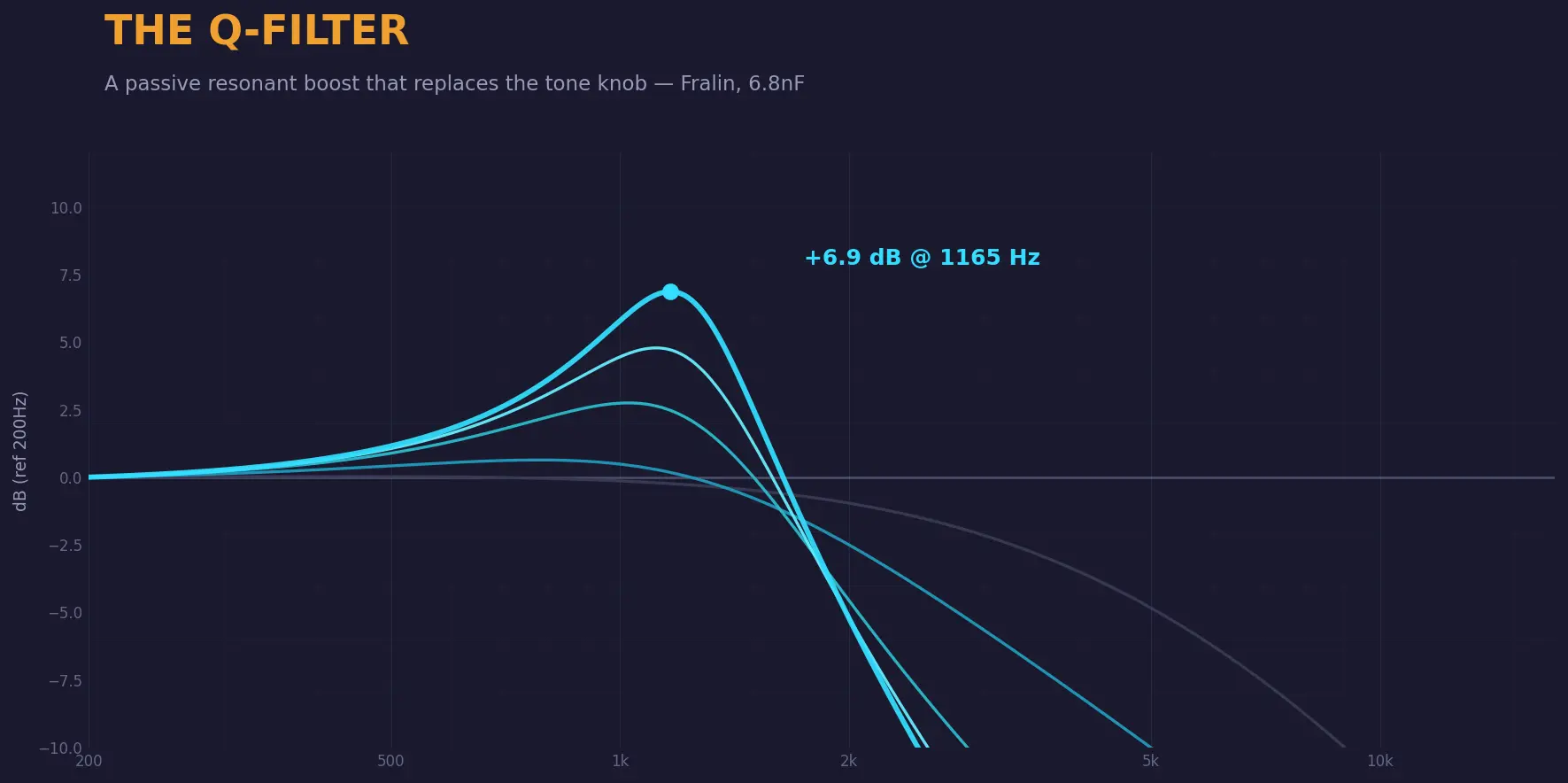
A bass with no tone control. The third knob moves the pickup’s resonant peak: open at one end for the Fralin’s natural voice, bright and glassy; rolled, the peak drops into P-bass bark. That was the design. It measured as promised, and two months of playing found the flaw in it.
The tone knob is a subtraction
A tone pot shunts the top end to ground through a cap. There’s no setting where it gives you more than the pickup already made.
The Fralin, in the sim, makes the least top of the three pickups in this build — the highest inductance of the three, vintage, mid-forward. Roll a tone pot down on it and it gets darker still. The idea was to build the opposite: a knob that gives the top back.
The correction that started this
The first version of this filter left a 50kΩ pot in circuit at its “off” end and called that flat. It wasn’t. Parked at 50kΩ the network was still shaving 6–8dB off the top on average, up to 17.5dB in the 1–8kHz band. The “off” position was a tone cut hiding as a neutral.
So the pot got no-load modded: a 2–3mm break in the resistive track at one end, so that end is a genuine open circuit. With the network truly gone, the Fralin’s natural resonance comes back: +11.3dB at ~6.5kHz in the sim, +12dB versus the stock harness on the bench.
The pickup was never mellow. The circuit around it was. The stock harness — two 250K pots and a tone cap — loads the pickup at roughly 125kΩ; the no-load harness loads it about four times lighter, and the peak the sim predicted arrived within a decibel.
What it does
A no-load 50kΩ reverse-log pot and one 1nF cap to ground. That’s the whole circuit.
One end is open. The filter is gone, the pickup runs wide, peak at ~6.5kHz. A bright, single-coil-like Jazz voice.
The other end engages the cap. 1nF resonates against the pickup’s inductance and the peak moves down — from ~6.5kHz to 2.8kHz with both pickups on (sim said 2.9k), about 2k soloing the bridge, 1.4k soloing the neck. Same riff, both settings, level-matched: presence (1.5–3kHz) up 4.4dB, resonance (3–5kHz) down 4.5dB, air (5–9kHz) down 8.5dB. The peak relocating from sheen to growl, exactly as drawn.
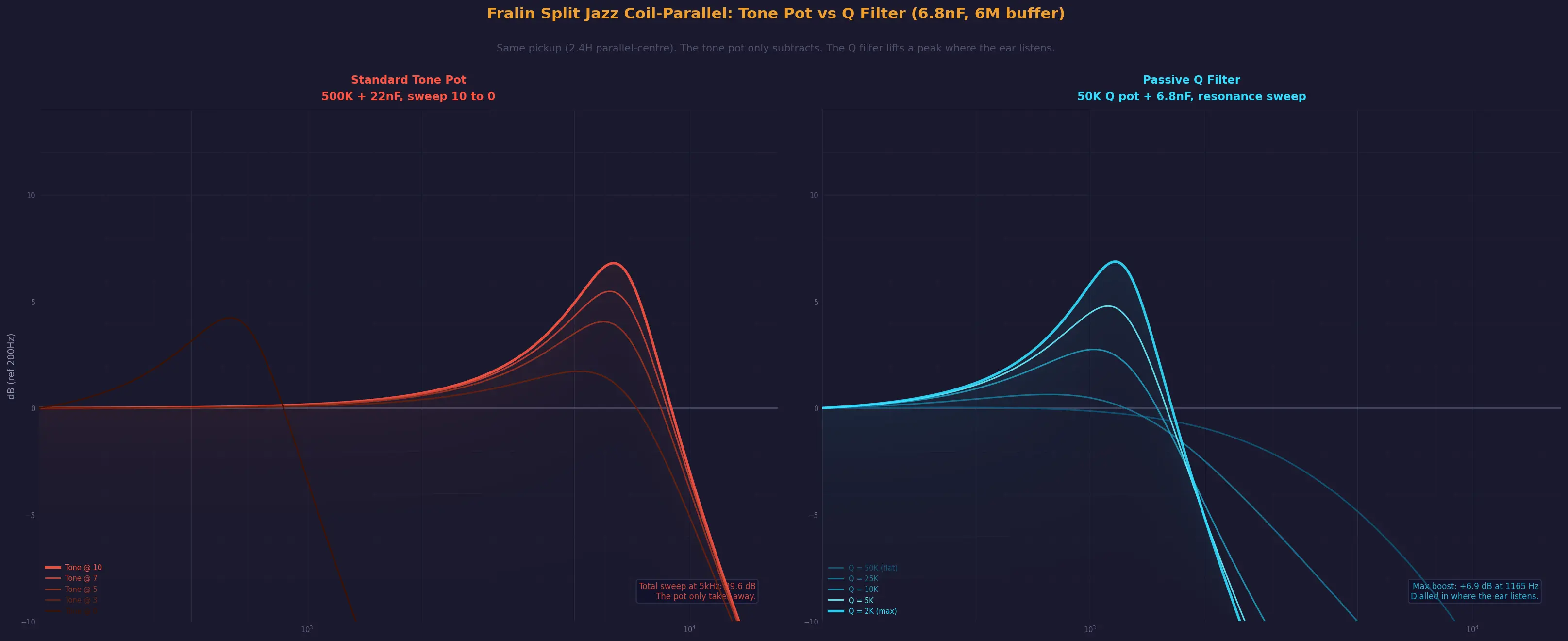
Left: what a tone pot does. Right: what the Q-filter does — it relocates the peak the pickup already has, across the stretch that separates a J from a P.
Why it’s a switch
1nF has 57kΩ of reactance at 2.8kHz. The pot in series with it runs 0–50kΩ. Across the whole rotation the cap’s load on the signal node only changes from 57kΩ to 76kΩ: the pot never moves the peak, it only damps it a little. The peak’s frequency is set by the cap and the pickup’s inductance, and those don’t change with the knob.
So the dial has two states. Open end: no-load, peak at 6.5k. Anywhere else: bark, peak at 2.8k, height trimmed a few dB by where the pot sits. Hand on the knob it feels like nothing, nothing, nothing, bark.
A real sweep needs a pot whose resistance is comparable to the cap’s reactance over most of the travel, and then it damps the peak flat before it has moved anywhere. Passive filters relocate resonances with capacitance, not resistance — which is what a switch with two or three caps does, and what this pot was pretending to do.
Two usable voices is still two voices. It’s just not a dial.
Why a boost there does anything
A bass puts about 99% of its raw energy below 500Hz. The ear doesn’t listen there.
The bark voice lives at 800Hz–2.8kHz — above where the bass makes its energy, square on where the ear pays attention. Strengthening the upper harmonics feeds the missing-fundamental effect, the trick the ear uses to reconstruct a low note it can’t hear. The bass reads as bass on a phone, a laptop, an earbud. MaxxBass, in analog, at the source, with one cap.
The push-pull
The volume pot pulls up. One move swaps two things: the coils go parallel → series, and the filter cap drops out.
| State | Coils | Cap | Sound |
|---|---|---|---|
| Down | Parallel | 1nF | Open or bark, per the Q knob. |
| Up | Series | none | Darker, fatter, raw. The Q knob does nothing here. |
Series stacks the coils, sums their voltage for roughly +10dB, drops the resonance an octave and thickens everything. A raw vintage humbucker at the top of the volume knob.
After two months this is the control that gets used. Blend centred, pull for the second bass, push for the first.
The signal chain
Fralin Split Jazz (parallel / series via push-pull)
  -> Blend (CTS 250K MN, far ends floating)
  -> Volume (CTS 500K log, DPDT push-pull)
  -> Q-filter (50K no-load rev-log + 1nF to ground, parallel only)
  -> Ring-hot buffer (2N5457 -> 2N3904)
  -> TRS out:  tip = passive direct   ring = buffered + phantom power
The output jack is a TRS: a plain TS cable in the tip pulls the passive bass straight off the pickups; a TRS cable feeds the ring, which carries the buffered signal and the phantom power that runs it — 18V in the studio, 9V for jamming. The cable is the switch.
What the buffer is for
Impedance, not tone. The compound 2N5457 → 2N3904 follower converts the pickup’s high-Z signal to low-Z at the source, so the cable stops loading the pickup. Sim-verified and built: 0.40% THD at 1.5Vpk, the passive path within 0.27dB of bypass.
Measured, at the desk: through a 3m cable into a 1MΩ instrument input, tip and ring sit within 2dB of each other in every band. Plugged into a line input by accident, the passive tip lost 10–14dB of top end and the ring didn’t move. That is the entire value of the buffer — the same tone into any input, any cable, any pedalboard. In a studio with a Hi-Z input and a short cable, it never gets used, and it costs about 10dB of signal-to-noise against the passive path (68dB passive, ~57dB buffered, gain-matched). Both floors are inaudible in a mix.
Why this instead of an active preamp
Active filter preamps — Alembic, Wal, ACG/John East — sweep frequency continuously, boost and cut, and cost $150–300 plus a battery in the body. This is one no-load pot and one cap. It can’t cut, and it can’t add a peak the pickup doesn’t have. It can open a vintage Fralin fully and drop its own resonance into the bark band.
On the bench, through the same harness, the three pickup sets in this build sat within about 3dB of each other above 3kHz. Changing the harness moved that band by 12.
What goes back in
The bark voice is good. The open voice is the problem: +12dB at 6.5kHz is a lot of attack on a fresh roundwound, and with no tone load the volume knob can’t tame it — it collapses the resonance before it touches the level (peak +10dB at 10, +4.5 at 9, gone at 7, while the level drops only 2.4 then 8dB). The volume acts as a tone control first.
The revision, simulated and parts on the bench:
- Q slot → 250K audio no-load tone pot, 22nF to ground. At 10 it is a true open circuit — today’s sound, untouched. At 9½ to 7 it takes 4–6dB off 3–5kHz and pulls the peak down toward 4k: the brittleness tamer. At 0, wool. The cap value only sets the full-dark depth; above 5 on the dial, 15nF and 47nF measure the same.
- Treble bleed, 1nF ∥ 150kΩ across the volume. At 7 the 3–5kHz band sits at +4dB instead of −5, level −3.7 instead of −7.9. Nothing at 10.
- DPDT pole 2 emptied. The 1nF bark cap comes off the push-pull. Series stays the raw voice.
- Buffer, blend, ground bus: untouched.
The tone knob is a subtraction. On a pickup opened this far, a subtraction was the missing control.
Paused, for now, on a knob problem — set-screw knobs on knurled shafts sit visibly skew, and the new pot goes in together with knobs that fit.
Parts
| Part | Spec | Cost estimate |
|---|---|---|
| Lindy Fralin Split Jazz (pair) | vintage-wind, hum-cancelling, 43 AWG, 11.5k/12k | ~$200 |
| Volume pot | CTS 500K log, DPDT push-pull, solid shaft | ~$12 |
| Blend pot | CTS 250K MN, centre detent | ~$8 |
| Q pot | CTS 50K reverse-log, no-load modded | ~$8 |
| Filter cap | 1nF ceramic disc | ~$0.20 |
| Buffer | 2N5457 → 2N3904 compound follower, half-rail divider bias | ~$5 |
| Output jack | Switchcraft 12B TRS — tip passive, ring buffered + power | ~$8 |
| Revision | CTS 250K audio no-load tone pot, 22nF film cap, 1nF + 150kΩ bleed | ~$12 |
Total electronics (excluding pickups): around $50. Build steps in the Volume · Q · Blend harness guide.
Companion to the Volume · Q · Blend harness and the pickup shootout.