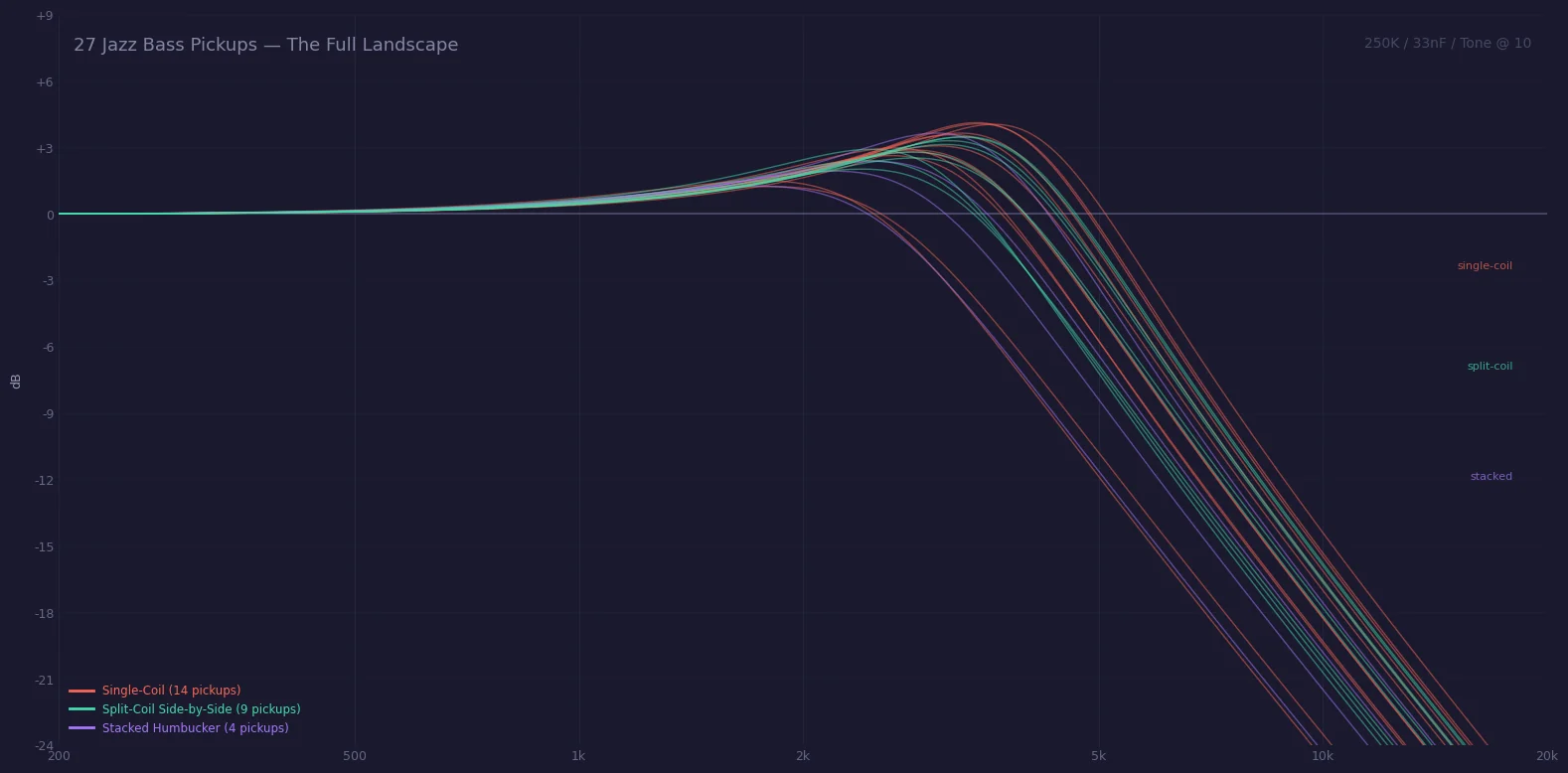
Pickups cost €80–150 each. You need two. You can’t return them soldered. So: a simulator. Python, the measured pickup data that exists, the actual circuit the signal passes through. Twenty-nine pickups on the same axes.
Two things came out of it. The spec-sheet number everyone quotes predicts almost nothing. And once three of these sets had been through the same bass and the same harness, the pickup turned out to be the smaller variable.
Reading the curves
All curves normalised to 0dB at 200Hz. The differences live above 1kHz.
The resonant peak. The bump in the upper mids. Where it sits defines the pickup’s character. Higher and later: brighter, more string attack. Lower and earlier: thicker, warmer.
Rolloff. How fast the curve drops after the peak. Every passive pickup rolls off monotonically past it; it has to.
One dimension of tone. Says nothing about dynamics, touch, or feel.
The full landscape
Architecture matters, but less than expected. The extremes hold: the brightest are single-coils, the darkest are stacked. In the middle, where the buying decisions live, it’s a mix. Some split-coils are brighter than some single-coils.
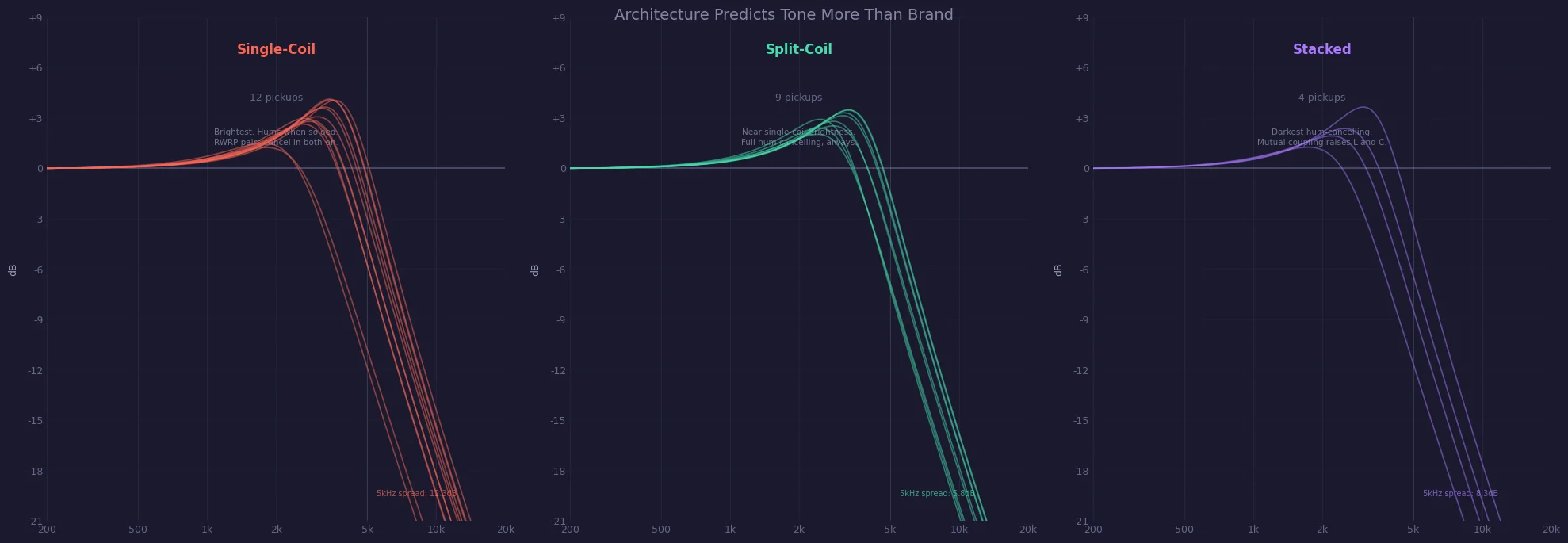
Single-coil. Widest variation. The lightest-wound vintage specs (the Am. Special stock set, CS ’60s, V-Mod II) sit bright. The overwound models (SJB-3, SJB-2) are darker than most hum-cancelling pickups. The Fender Pure Vintage ‘74 (full GuitarNutz2 measurements: L=3.65H avg, C=140pF) lands mid-pack despite its reputation. The “70s brightness” comes from the 70s bridge-pickup position, 10mm closer to the bridge, not from the coil. All of them hum when soloed. In a studio that 50Hz is always there.
Split-coil (side-by-side). Each coil senses two strings, wired in hum-cancelling series. Huge spread: Delano JMVC at −1.6dB to the Reverend Jazz Bomb at −11.6dB. The Bartolini 9J sits dark despite the lowest DCR in the group — ceramic magnet, steel blades, high-permeability cores pushing inductance far above what the resistance suggests.
Stacked humbucker. The Wilde J-45N (Bill Lawrence’s coaxial “Noisefree” design) has the lowest Q in the sim, 8.2: its 20kΩ of DCR damps the resonance so hard there is no peak at all, flat upper mids straight into rolloff. Stacking two coils vertically raises effective inductance and capacitance, which is why the SJB-5 and Ultra Noiseless come out the darkest hum-cancelling pickups here.
DCR is the wrong number
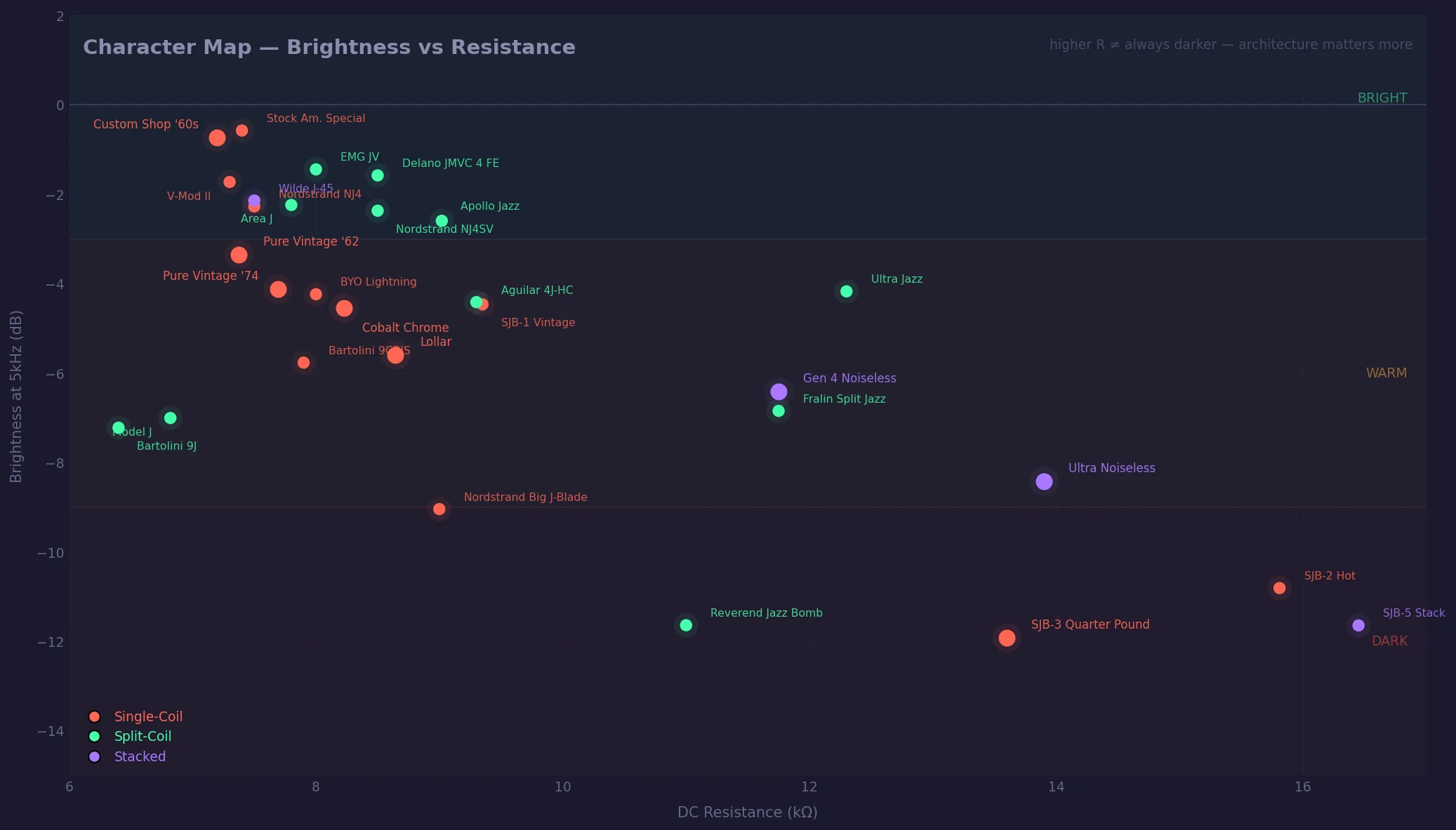
If DC resistance set the tone, the dots would sit on one diagonal. They don’t.
Stock Ceramic, the MIM/Squier pickup. 5.74kΩ, the lowest in the lineup, measured. Its steel slug poles push inductance to 4.08H, higher than the Alnico CS ’60s at 2.66H. Darker than pickups with twice its resistance. Three kilohms less than the Lollar (8.65kΩ, 4.19H) and darker than that too. The SJB-3 Quarter Pound, 13.6kΩ and 6.72H measured, is the darkest in the sim: quarter-inch Alnico 5 poles and 244pF of coil capacitance pull its resonance down to 3.85kHz.
DCR tells you how much wire is on the bobbin. Inductance tells you what the wire is wound around. Steel slugs are cheap and high-permeability; Alnico rods are expensive and low-permeability. The spec sheet says “5.7kΩ” and you think bright.
The measured pickups (solid borders) anchor the estimates. A measured single-coil at 3.65H sits at −4.1dB; an estimated one at 3.8H should sit near −4.5dB, and does.
Lollar is the one major maker that publishes inductance for the whole line. The Echoes of Mars database has independently measured the bridge: 9.69kΩ, 4.881H, 131pF — well above Lollar’s own 8.5kΩ/4.0H. Sample variance, or an old spec. The sim uses the measured bridge averaged with the published neck: 4.19H, −5.6dB at 5kHz. Warm-vintage territory, almost the PV ‘74’s twin.
The full ranking
Ranked by 5kHz level through the stock circuit. Not a quality ranking: a brightness ranking. The hypothesis behind it: brighter captures more harmonic information for a DI — you can EQ darker, you can’t recover what rolled off before the converter. Adjacent positions within 1dB are within margin.
| # | Pickup | Type | Silent | R | L | 5kHz | Data |
|---|---|---|---|---|---|---|---|
| 1 | Fender Am. Special (stock) | SC | no | 7.0kΩ | 2.65H | -0.7dB | derived |
| 2 | Fender Custom Shop '60s | SC | no | 7.2kΩ | 2.66H | -0.7dB | measured |
| 3 | Delano JMVC 4 FE | SP | yes | 8.5kΩ | 3.00H | -1.6dB | estimated |
| 4 | Fender V-Mod II | SC | no | 7.3kΩ | 3.00H | -1.7dB | derived |
| 5 | DiMarzio Area J | SP | yes | 7.8kΩ | 3.20H | -2.2dB | estimated |
| 6 | Nordstrand NJ4 | SC | no | 7.5kΩ | 3.10H | -2.3dB | estimated |
| 7 | Nordstrand NJ4SV | SP | yes | 8.5kΩ | 3.20H | -2.4dB | estimated |
| 8 | EMG JV-HZ (passive) | SP | yes | 7.2kΩ | 3.24H | -2.4dB | vendor |
| 9 | SD Apollo Jazz | SP | yes | 9.0kΩ | 3.30H | -2.6dB | estimated |
| 10 | Fender Pure Vintage '62 | SC | no | 7.4kΩ | 3.27H | -3.3dB | vendor |
| 11 | Fender Pure Vintage '74 | SC | no | 7.7kΩ | 3.65H | -4.1dB | measured |
| 12 | DiMarzio Ultra Jazz | SP | yes | 12.3kΩ | 3.80H | -4.2dB | estimated |
| 13 | BYO Lightning | SC | no | 8.0kΩ | 3.73H | -4.2dB | derived |
| 14 | Aguilar 4J-HC | SP | yes | 9.3kΩ | 3.80H | -4.4dB | estimated |
| 15 | SD SJB-1 Vintage | SC | no | 9.3kΩ | 3.75H | -4.5dB | estimated |
| 16 | Fender Cobalt Chrome | SC | no | 8.2kΩ | 3.88H | -4.5dB | measured |
| 17 | Wilde J-45N | ST | yes | 20.0kΩ | 4.00H | -4.9dB | measured |
| 18 | Lollar Jazz Bass | SC | no | 8.6kΩ | 4.19H | -5.6dB | measured |
| 19 | Bartolini 9CBJS | SC | no | 7.9kΩ | 4.00H | -5.8dB | estimated |
| 20 | Fender Stock Ceramic | SC | no | 5.7kΩ | 4.08H | -6.0dB | measured |
| 21 | Fender Gen 4 Noiseless | ST | yes | 11.8kΩ | 4.40H | -6.4dB | measured |
| 22 | Fralin Split Jazz | SP | yes | 11.8kΩ | 4.80H | -6.8dB | estimated |
| 23 | Bartolini 9J | SP | yes | 6.4kΩ | 4.40H | -7.2dB | estimated |
| 24 | Fender Ultra Noiseless | ST | yes | 13.9kΩ | 5.20H | -8.4dB | measured |
| 25 | Nordstrand Big J-Blade | SC | no | 9.0kΩ | 5.50H | -9.0dB | estimated |
| 26 | SD SJB-2 Hot | SC | no | 16.4kΩ | 6.75H | -10.8dB | estimated |
| 27 | Reverend Jazz Bomb | SP | yes | 11.0kΩ | 7.15H | -11.6dB | estimated |
| 28 | SD SJB-5 Stack | ST | yes | 15.7kΩ | 7.00H | -11.7dB | estimated |
| 29 | SD SJB-3 Quarter Pound | SC | no | 13.6kΩ | 6.72H | -11.9dB | measured |
SC = single-coil. SP = split-coil side-by-side. ST = stacked humbucker. Silent = hum-cancelling in every switch position. 5kHz = level relative to 200Hz, tone wide open, 250K pots, 500pF cable, 1MΩ load. Data: green = third-party measured or builder-confirmed; vendor = manufacturer-published R and L; derived = one value published, the other from a measured sibling; estimated = R from spec, L from the L/R rule (see Methodology). Click any column header to sort.
Top two are single-coils with the least wire on the bobbin: the set Fender shipped in the American Special and the Custom Shop ’60s. The CS ’60s has full measured data and validates the model — its measured resonant peaks (3.51kHz bridge, 3.81kHz neck, 470pF load) track the sim within 5% — and it’s the measured pickup the stock set’s inductance is borrowed from, so the two sit together by construction.
The first hum-canceller is the Delano at #3, then the Area J at #5 and the EMG JV-HZ at #8. DiMarzio’s own lineup shows the range inside one factory:
| Area J | Ultra Jazz | |
|---|---|---|
| Architecture | Split-coil | Split-coil |
| DCR | 7.80kΩ | 12.3kΩ |
| Output | 155mV | 250mV |
| Treble (4-band) | 4.5 | 7.0 |
Both split-coil side-by-side — DiMarzio tech support: “All of our Jazz Bass pickups are split humbuckers.” The Ultra Jazz has the higher DCR and the higher treble rating; its hybrid magnet (Alnico 5 rods plus a ceramic bar) reduces inductance per ohm. The Area J runs Alnico 2 and sits darker on paper. Magnet, not architecture, sorts this family.
The Bartolini 9J at #23 makes the point hardest: the lowest DCR of any hum-canceller (6.4kΩ) and −7.2dB at 5kHz. The three darkest are all past 6H. At that inductance the rolloff starts in the upper mids.
Same pickups, different circuit
Cable capacitance sits on the pickup node directly, in parallel, whatever the pot value. A 500K volume pot doesn’t shield the pickup from the cable. For the Ultra Noiseless at 5.2H, cable versus no cable is 13dB at 5kHz. The Volume·Q·Blend harness — 500K volume, no tone pot, a buffer on the ring of a TRS jack — changes the loading in two distinct steps.
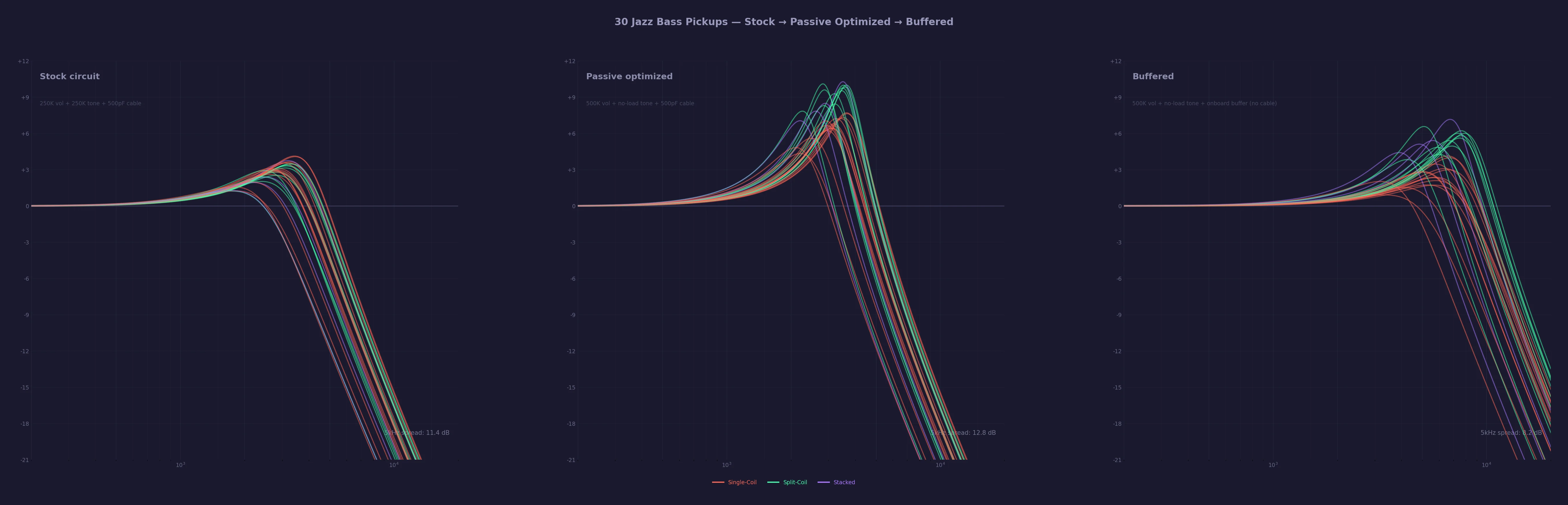
Left: stock. Centre: passive optimised — 500K volume, no tone pot, cable still there. Right: buffered, the ring-hot buffer driving the cable from a low impedance so the pickup never sees it.
The pots alone do little, and they do it unevenly. The 500pF is still on the pickup node, and for a high-inductance coil that is the dominant load. The passive spread is wider than stock (12.6dB against 11.2): the low-inductance pickups gain most from the pot change, the high-inductance ones stay crushed. The Ultra Noiseless picks up +0.5dB from the pots. The stock Fender, which needed help least, picks up +1.6.
The buffer

For single-coils the pot change (gold) is the bigger share; they were never heavily loaded. For the stacked humbuckers the buffer (cyan) is everything: the SJB-5 gains +0.2dB from pots and +15.2dB from the buffer, the Ultra Noiseless +0.5 then +15.2. Their distributed capacitance was resonating with the cable, a double penalty.
Those are worst-case figures against a 500pF cable. On a short quality cable (~200pF) the buffer’s gain shrinks toward 0–2dB, and the whole effect lands at 5kHz, two octaves above the highest note on the instrument. The Fralin Split Jazz gains +1.0dB from the pots and +10.7 from the buffer, all of it in a band the strings barely excite. The buffer takes the cable out of the tone. How much that is worth depends entirely on the cable.
The buffered ranking
| # | Pickup | Type | Silent | 5kHz | Total Gain | Stock # | Data |
|---|---|---|---|---|---|---|---|
| 1 | Bartolini 9J | SP | yes | +8.8dB | +16.0 | 23 | estimated |
| 2 | Fender Ultra Noiseless | ST | yes | +7.3dB | +15.7 | 24 | measured |
| 3 | Fender Gen 4 Noiseless | ST | yes | +6.5dB | +12.9 | 21 | measured |
| 4 | Reverend Jazz Bomb | SP | yes | +5.5dB | +17.1 | 27 | estimated |
| 5 | Wilde J-45N | ST | yes | +5.1dB | +10.0 | 17 | measured |
| 6 | Fralin Split Jazz | SP | yes | +4.8dB | +11.7 | 22 | estimated |
| 7 | Aguilar 4J-HC | SP | yes | +4.5dB | +8.9 | 14 | estimated |
| 8 | Bartolini 9CBJS | SC | no | +4.0dB | +9.7 | 19 | estimated |
| 9 | Fender Stock Ceramic | SC | no | +3.9dB | +10.0 | 20 | measured |
| 10 | Fender Pure Vintage '62 | SC | no | +3.9dB | +7.3 | 10 | vendor |
| 11 | DiMarzio Ultra Jazz | SP | yes | +3.9dB | +8.1 | 12 | estimated |
| 12 | Nordstrand NJ4SV | SP | yes | +3.8dB | +6.2 | 7 | estimated |
| 13 | SD SJB-5 Stack | ST | yes | +3.7dB | +15.4 | 28 | estimated |
| 14 | Fender Am. Special (stock) | SC | no | +3.6dB | +4.2 | 1 | derived |
| 15 | Fender Custom Shop '60s | SC | no | +3.6dB | +4.3 | 2 | measured |
| 16 | Delano JMVC 4 FE | SP | yes | +3.5dB | +5.1 | 3 | estimated |
| 17 | SD Apollo Jazz | SP | yes | +3.5dB | +6.1 | 9 | estimated |
| 18 | EMG JV-HZ (passive) | SP | yes | +3.5dB | +5.9 | 8 | vendor |
| 19 | DiMarzio Area J | SP | yes | +3.4dB | +5.7 | 5 | estimated |
| 20 | Nordstrand NJ4 | SC | no | +3.1dB | +5.4 | 6 | estimated |
| 21 | SD SJB-1 Vintage | SC | no | +3.0dB | +7.5 | 15 | estimated |
| 22 | Fender Pure Vintage '74 | SC | no | +2.9dB | +7.1 | 11 | measured |
| 23 | Fender V-Mod II | SC | no | +2.8dB | +4.5 | 4 | derived |
| 24 | BYO Lightning | SC | no | +2.7dB | +6.9 | 13 | derived |
| 25 | Lollar Jazz Bass | SC | no | +2.6dB | +8.2 | 18 | measured |
| 26 | Nordstrand Big J-Blade | SC | no | +2.4dB | +11.5 | 25 | estimated |
| 27 | Fender Cobalt Chrome | SC | no | +2.4dB | +6.9 | 16 | measured |
| 28 | SD SJB-2 Hot | SC | no | +0.9dB | +11.6 | 26 | estimated |
| 29 | SD SJB-3 Quarter Pound | SC | no | -0.6dB | +11.3 | 29 | measured |
5kHz = level relative to 200Hz through the buffered circuit. Total Gain = change from the stock circuit at 5kHz (pots + buffer). Stock # = position in the stock ranking above.
The Bartolini 9J: #23 stock, #1 buffered. Ceramic and steel blades gave it the highest inductance-to-resistance ratio in the database, which made it the most cable-loaded pickup of the lot, with the most to get back. The Fralin: #22 stock, unmoved by the pot change, #6 buffered. Every hum-canceller that was paying a cable penalty lands in the top half once the cable is gone. The single-coils compress into a cluster around +2 to +4dB; they were never far apart. The overwound SJB-2 and SJB-3 stay last. Past 6.7H they roll off in the upper mids whatever the load.
The thickness shift
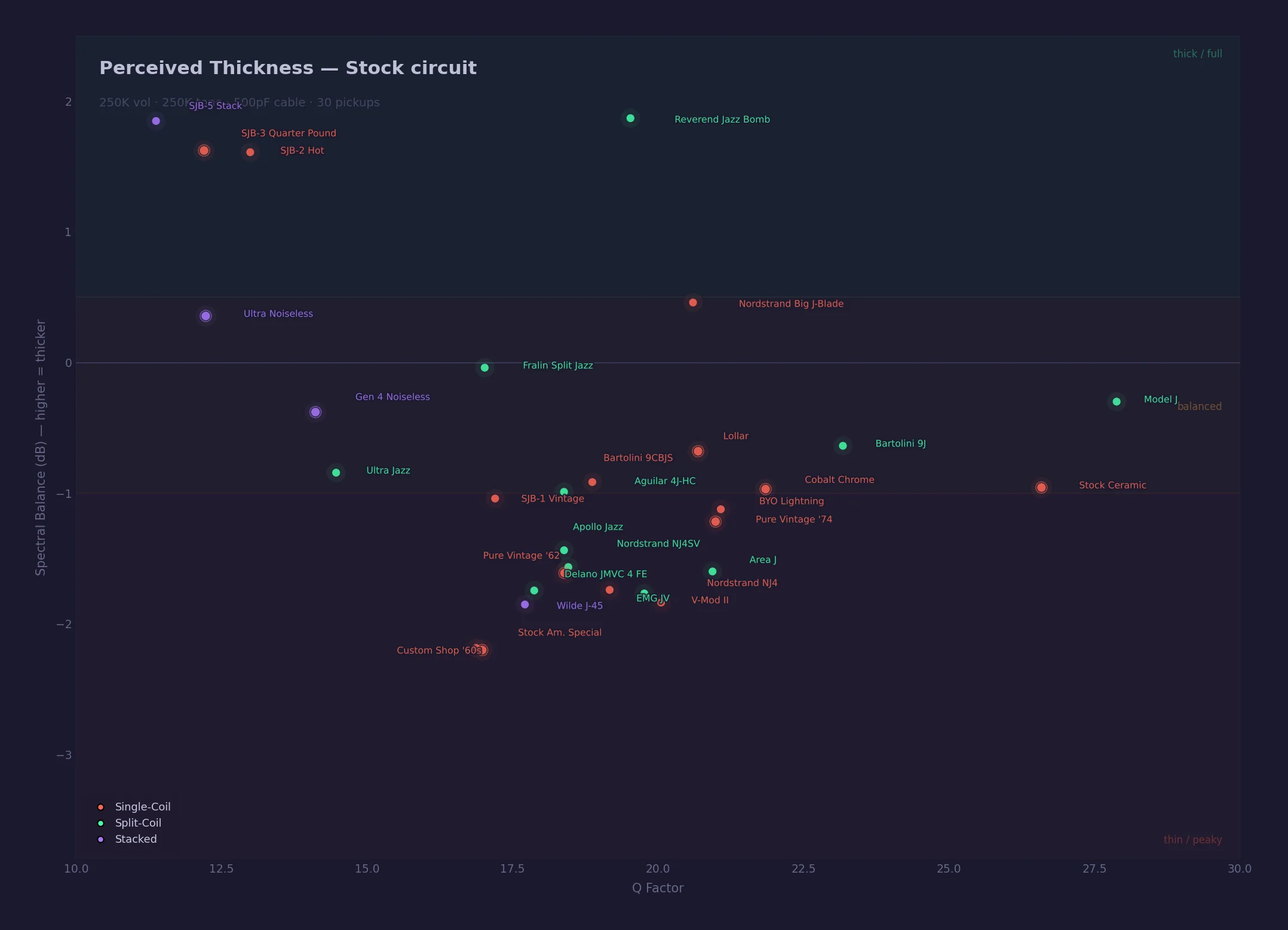
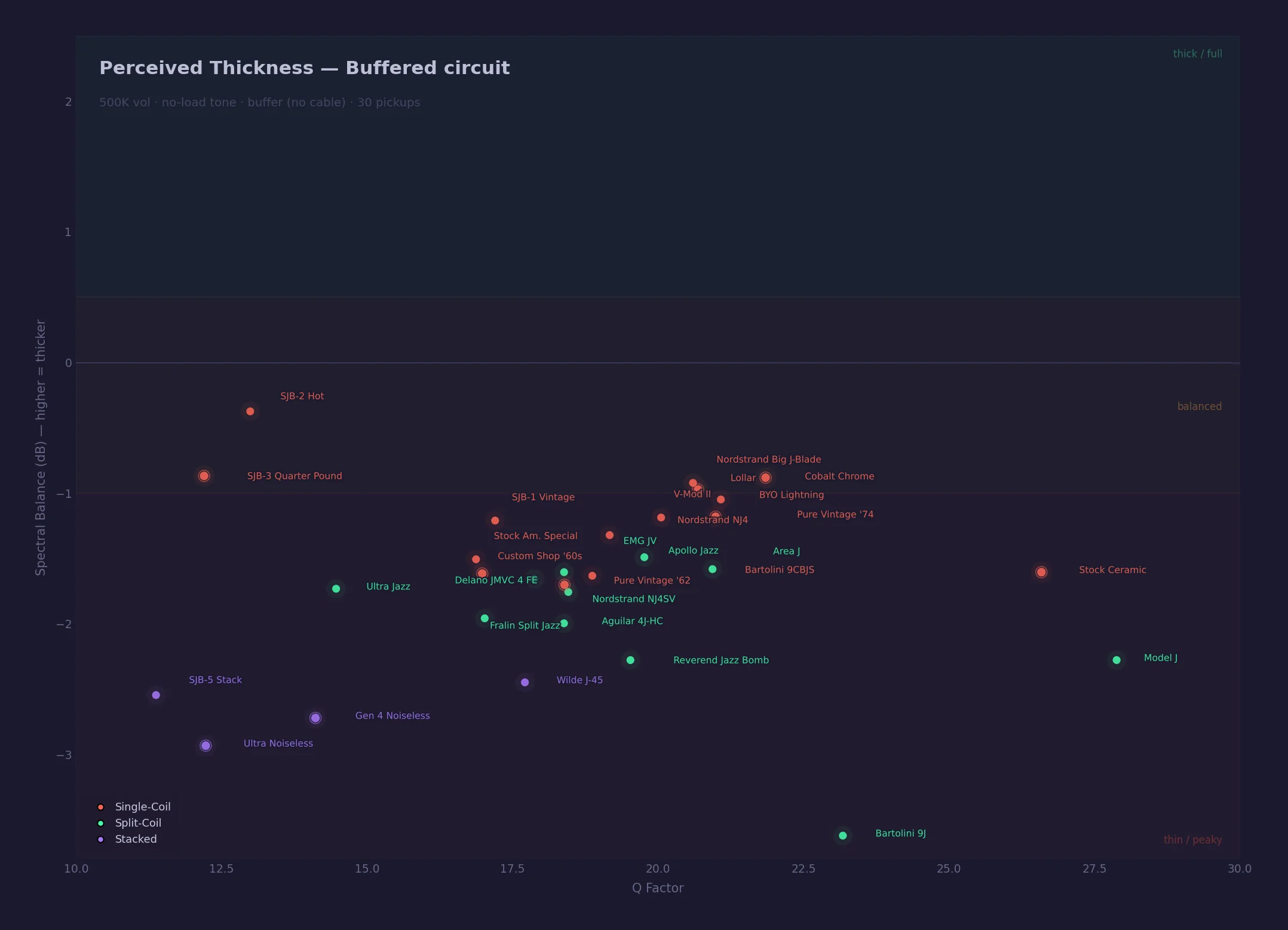
Spectral balance — energy at 80–400Hz against 1.5–6kHz — tells the other half. In the stock circuit the high-inductance pickups (Fralin, Bartolini 9J) read thick. The cable was flattening their peaks. Take it away and every pickup shifts thinner: the 9J from −0.6 to −4.8, the Fralin from 0.0 to −2.7. Their warmth was borrowed from the cable. Most of that shift sits above where the strings put energy, so what the player gets is consistency: the same pickup into any cable, any input.
What the bench said
The simulator ranks pickups. It was built to choose one, and it did — the Fralin, for the hum. Then three sets went through the same bass, the same stock harness, the same interface and the same riff, level-matched at 80–250Hz, and the ranking stopped being the interesting result.
Pickup swap, stock harness. Fralin Split Jazz against the stock single-coils, both pickups on: +1.3dB at 3–5kHz, +1.8dB at 5–10kHz. Soloed neck: −2.2 and −2.8. Soloed bridge: +1.1 and +4.1. The two sessions were a day apart, so anything under 2dB is inside what pickup height and a different day’s hands can move. Aguilar 4J-HC, same day as the Fralin: +2.8 and +5.9 over stock with both on — the brightest of the three, and not by a lot.
Harness swap, same pickups. Stock 250K/250K/tone-cap harness to the no-load harness, buffered path: +12dB at 6.5kHz. The sim had said +11.3.
The pickup change moved the sound by about 2dB. The harness moved it by 12. Hum-free is duller than a true single-coil, and the gap is smaller than forum consensus, small enough for a different harness to erase several times over.
Hum. A stock single-coil soloed puts about −70dBrms of hum on the line. The Fralins in a shielded cavity: −89dBrms, any position. That 19dB is the one difference between the sets a harness can’t touch.
The buffer. Through a 3m cable into a 1MΩ instrument input the passive tip and the buffered ring sit within 2dB of each other in every band. Into a line input by accident, the tip lost 10–14dB of top and the ring didn’t move. At a desk with a Hi-Z input and a short cable the buffer changes nothing audible, and it costs about 10dB of signal-to-noise against the passive path (68dB versus ~57, gain-matched; both inaudible in a mix). Its value is immunity — the same bass into any cable, any pedalboard, any input — and immunity is only worth something away from the desk.
One reconciliation the bench forced. The sim carries the Fralin at 4.8H, an estimate from its 11.75k of DCR and the 42-AWG rule of thumb, and on that number it should sit several dB under the stock set at 5kHz. The bench had it level. Fralin winds the Split Jazz with 43 AWG: thinner wire, more ohms per turn, so the DCR overstates the coil and the real inductance is probably nearer 4H. That closes part of the gap, not all of it. The measured 6.5kHz peak fixes the L×C product rather than L alone, so the curves in the charts stand; the 4.8 is the number with the error bar on it.
Why some pickups sound thicker
Numbers at 5kHz don’t say what a pickup does in a mix. The PV ‘74 sits either side of the guitar-and-vocal midrange, a treble peak giving transient definition over a solid, even bottom. A ceramic/steel pickup like the Bartolini 9J does the opposite: the peak sits lower, the midrange clanks, and it reads as aggressive rather than dark.
Thickness. Audible at matched levels. It comes from how sharply the resonant peak concentrates the pickup’s energy.
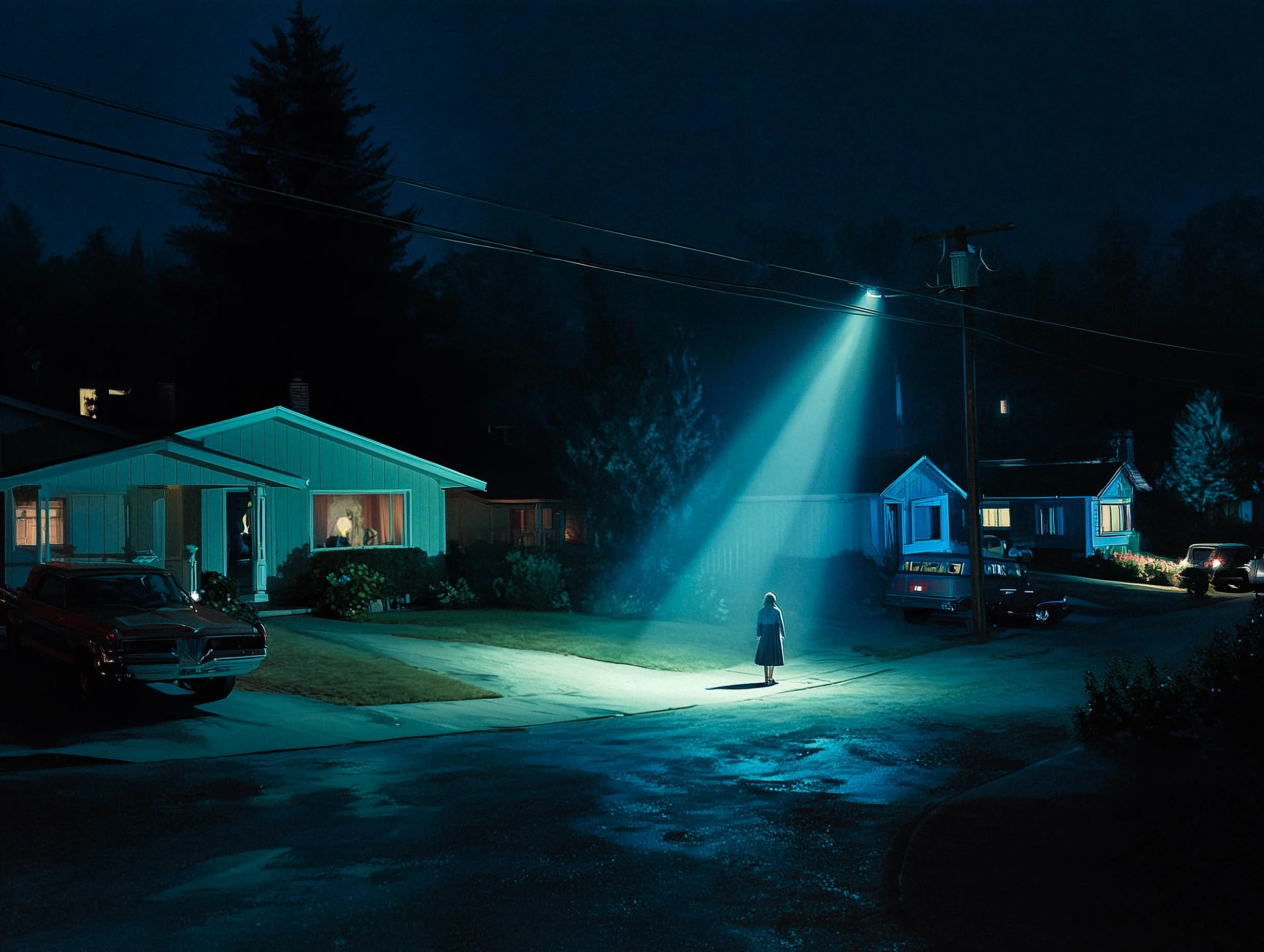
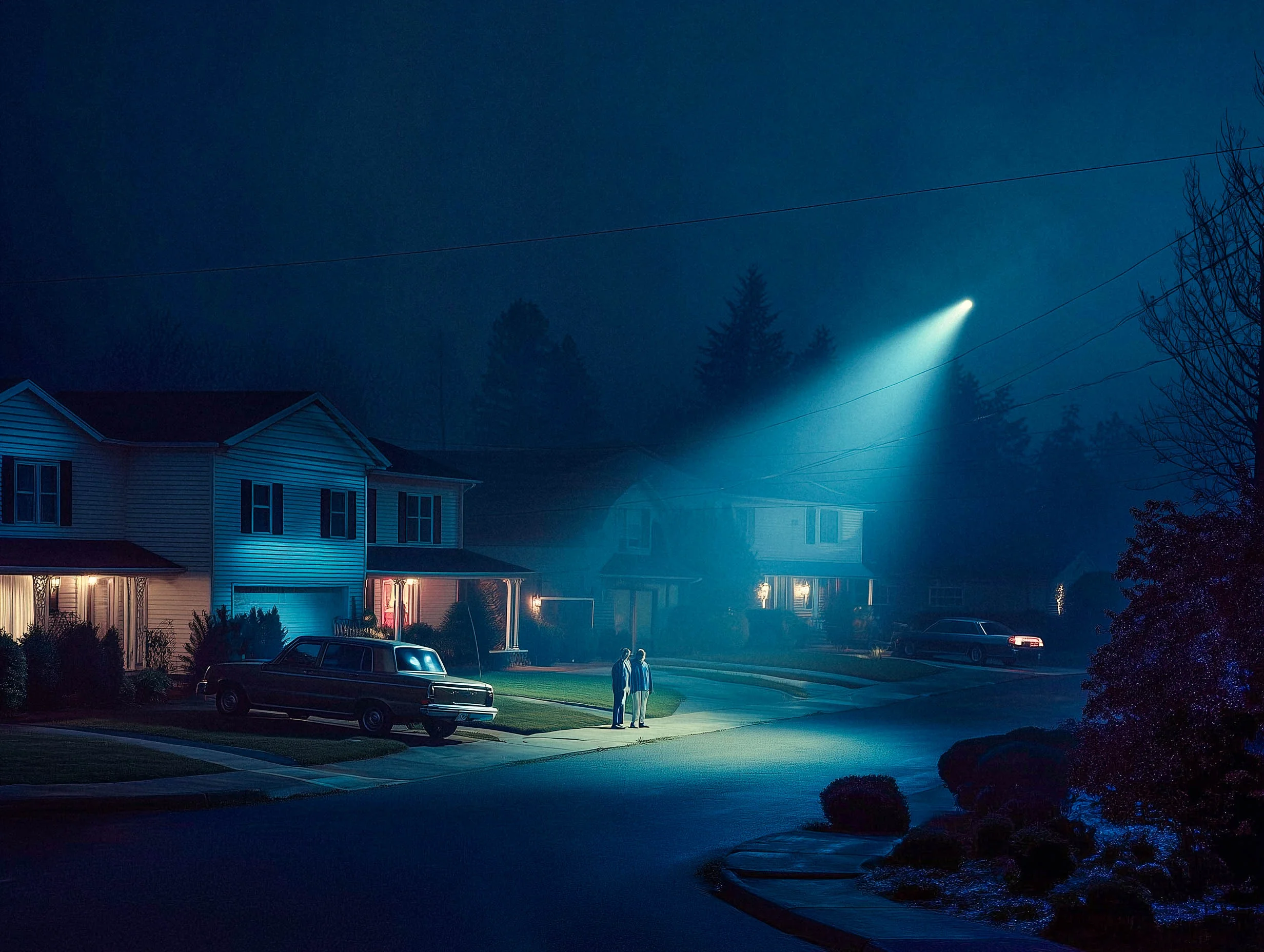
Same bulb. Q factor is the beam width: a high-Q pickup concentrates its resonant energy in a narrow band, a low-Q pickup spreads it. Same string energy either way; Q changes what the ear notices.
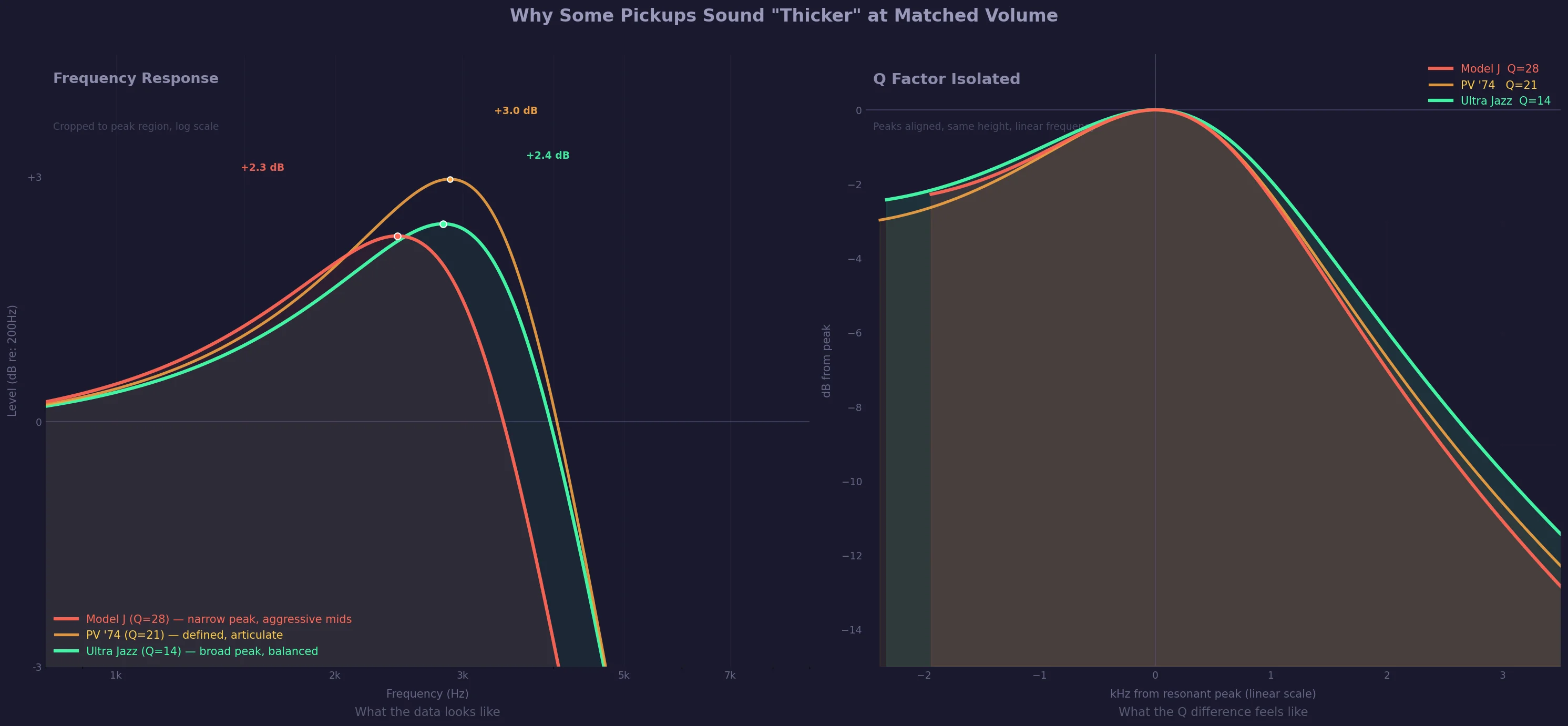
The 9J runs a tall, narrow peak, but 4.4H puts it so low that the concentrated energy lands where the ear reads midrange presence. That’s the clank. The PV ‘74 at Q=21 is still sharp but sits higher: snap on the attack, low-mids untouched. The Ultra Jazz at Q=14.5 spreads the most, broad and even, nothing dominating.
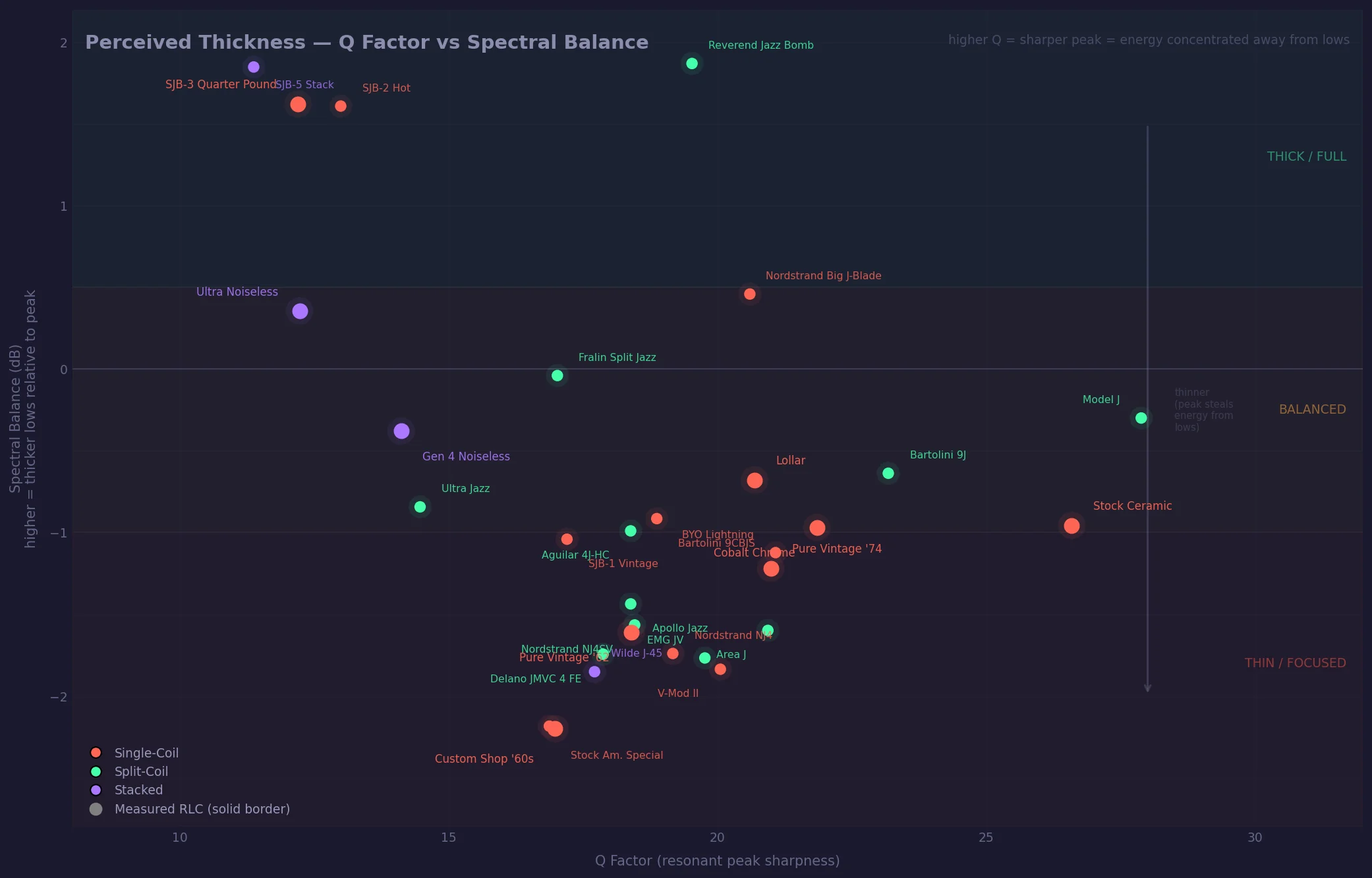
The overwound pickups (SJB-2, SJB-3, SJB-5) cluster top-left: low Q but thick, their peaks too low to steal from the fundamentals. The vintage single-coils: moderate Q, thin. The ceramic/steel pickups sit far right, high Q, but with peaks in the mids rather than the treble, so they read balanced. The Fralin is the thickest of the shortlisted hum-cancellers, balance ≈ 0.
One pickup, the whole database
Fender Ultra Noiseless. #24 stock, #2 buffered; +0.5dB from the pots, +15.2 from the buffer. Measured RLC, silent in every position.
With the buffer in place, a small cap from hot to ground at the blend-pot input moves the resonant peak down without touching the coil. Without the buffer the Ultra Noiseless is stuck at −7.9dB whatever the cap.
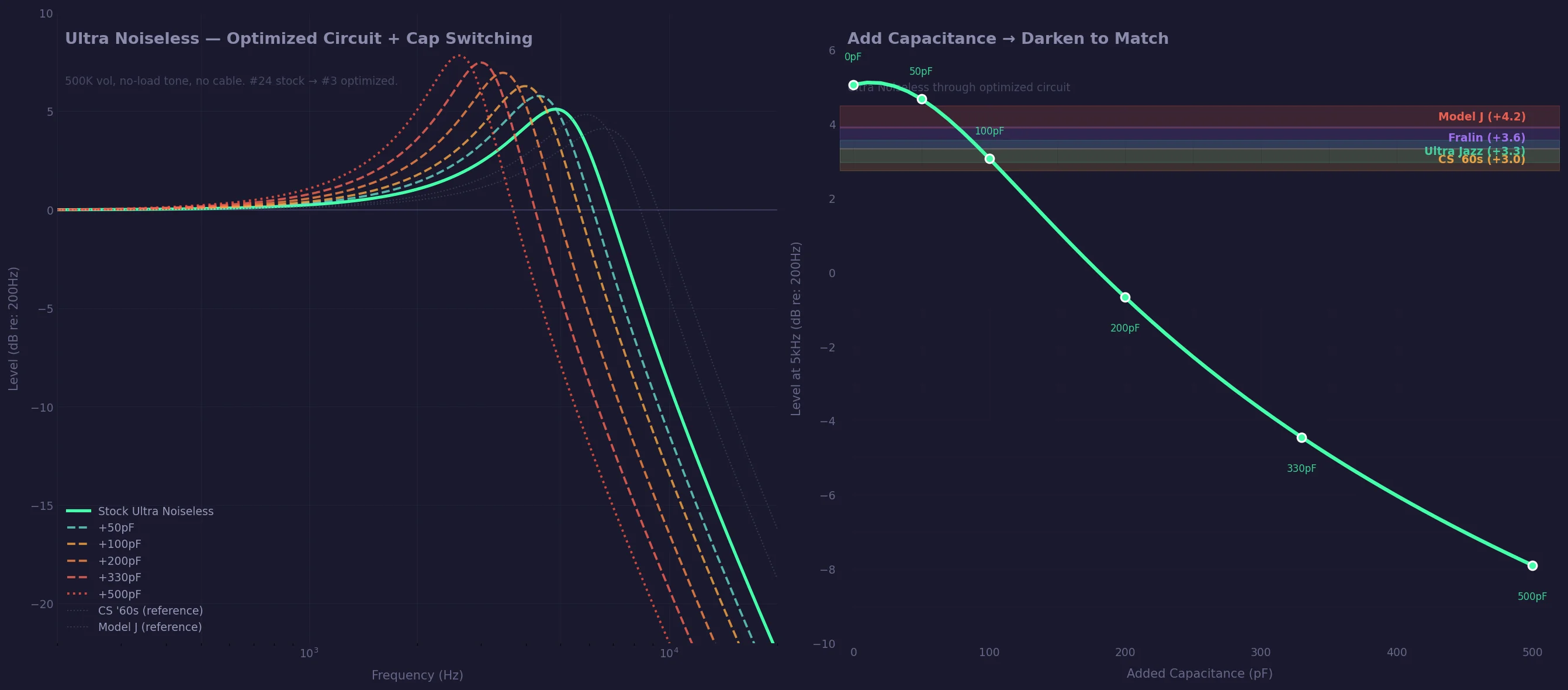
Buffered baseline +7.3dB at 5kHz. Add 100pF and it drops into CS ’60s / Fralin territory (+4.3). 200pF, flat at the top (−0.3). 500pF, darker than everything in the stock ranking except the five darkest, and still brighter than its own stock value (−8.4). Fifteen decibels of range on one set of coils. That cap-and-resistor made into a knob is the Q-filter in the build — and everything it moves lives above 1kHz, where the strings barely reach.
Methodology
Every pickup is an RLC circuit: a second-order resonant lowpass, flat through bass and mids, a peak in the upper harmonics, monotonic rolloff after. The simulator models the full chain — pickup, blend, volume, tone circuit, cable capacitance, load — with the same circuit for all 29. Charts: 250K pots, tone wide open, 500pF cable (a long or budget run; a quality 3m cable measures closer to 200pF), 1MΩ load, matching the UCX II Hi-Z input. With 250–500K pots in the path the pots dominate the resistive load; the cable capacitance sits on the pickup node regardless, which is the effect the three-tier comparison isolates.
Data tiers. Nine pickups have measured R and L: five from independent Echoes of Mars / GuitarNutz2 measurements (CS ’60s, PV ‘74, Stock Ceramic, Lollar, SJB-3), three from Fender data (Cobalt Chrome, Gen 4 and Ultra Noiseless), the Wilde J-45N confirmed by Bill Lawrence. Two carry manufacturer-published R and L: Fender Pure Vintage ‘62 (7.25k/3.2H neck, 7.5k/3.35H bridge) and EMG JV-HZ (EMG’s own instruction sheet: 6.83–7.60k, 3.0–3.48H for the Alnico 2 set). Three are derived — one value published, the other taken from a measured sibling: BYO Lightning, V-Mod II, and the stock Am. Special set (Fender’s service parts 0058358/9, the same pickup as the Highway One and Classic ’60s: 42 AWG, 7,800 turns, Alnico 5, 6.7–7.2kΩ, with L from the near-identical CS ’60s). The remaining fifteen: R from the maker’s spec, L from an L/R rule — 0.41 H/kΩ for Alnico single-coils, ~0.69 for ceramic-and-steel, higher for stacks.
A note on the EMG. Earlier versions of this table listed an “EMG JV” as a passive set. EMG’s JV Set is active; the passive part is the JV-HZ, and the row now carries EMG’s published figures for it.
How good is the 0.41 rule? Measured 42-AWG Alnico J coils cluster at 0.45–0.50 H/kΩ (seven samples, median 0.476); Fender’s own published pairs run 0.39–0.47. So 0.41 sits at the low end of the evidence, and the estimated Alnico rows may all run about 10% dark on inductance — roughly 1dB at 5kHz, shifting them together rather than reordering them. It’s left as is rather than re-tuned, and stated here. Wire gauge matters more: 43 AWG gives about 0.77× the inductance per ohm of 42, which is why the Fralin’s 4.8H is the least trusted number in the database (see above). The ceramic/steel rule rests on one measured J pickup and one guitar pickup; Zollner calls a single inductance for steel-pole pickups a drastic simplification, and ±15% is fair. Where published and measured specs diverge (Lollar), the sim uses the measured value.
What’s missing. String and body resonance, eddy-current damping, magnetic field geometry, nonlinear effects. The sim captures the passive electronics.
Four made the shortlist. Four pickups, every circuit.