I’m building the ultimate studio Jazz Bass. New shielding, new harness, new pickups. The problem: pickups cost €80-150 each, you need two, and you can’t return them once they’re soldered in.
So I built a simulator instead. Python, manufacturer specs, and the actual circuit the signal passes through. Twenty-four pickups plotted on the same axes. No vibes, no forum opinions. Just math.
How it works
Every pickup is an RLC circuit: resistance, inductance, capacitance.
Where the specs come from. DC resistance: always from manufacturer data sheets. Inductance: Fender publishes it for most models. The SD SJB-3 Quarter Pound has independent LCR measurements from antigua’s Echoes of Mars database (L=6.72H, C=254pF). The Lollar bridge was measured at 4.88H by the same source. For pickups with no published or measured inductance (most of the DiMarzio, Aguilar, Fralin, Nordstrand, Bartolini, and EMG models), values are estimated from the L/R ratio (~0.41 H/kΩ for 42AWG Alnico 5 single-coils), adjusted for architecture. These estimates carry ±15-20% uncertainty. Each value in the sim is tagged as measured, derived, or estimated.
The simulator models the full signal chain: pickup → blend pot → volume pot → tone circuit → cable capacitance → load. Same circuit for all 24 pickups. Normalize to 0 dB at 200 Hz and the differences jump out.
Load: 1MΩ. A Hi-Z audio interface input (RME UCX II), not a 10MΩ scope probe. The lower load resistance damps the resonant peak. Expect 3–6dB peaks here versus the 10–15dB spikes in unloaded bench measurements. Add 250K pots in parallel and the effective load drops further. These curves show what the DAW receives, not what the pickup does into an open circuit.
Below 1 kHz, every pickup sounds the same. The character lives in the upper harmonics: where the resonant peak sits, how tall it is, how fast it rolls off after.
All charts: 250K pots, 33nF tone cap, tone wide open, 500pF cable (typical 3m), 1MΩ load.
Reading the curves
All curves normalized to 0dB at 200Hz. The differences live above 1kHz.
The resonant peak. The bump in the upper mids. Where it sits defines the pickup’s character. 4–5kHz: present, articulate, string attack. 2–3kHz: thicker, more nasal. Higher peak = brighter tone.
Peak height. Tall and narrow sounds focused or honky. Low and broad sounds smooth. Neither is better.
Rolloff. How fast the curve drops after the peak. Steep = warm and filtered. Gentle = open and airy. Single-coils roll off gently. Stacked humbuckers drop fast.
Context matters. A flat, bright pickup captures the most information. You can EQ darker in the mix. A pickup with a lower peak and faster rolloff does the filtering for you, less flexibility but less work. For studio DI (this build), more information reaching the DAW wins. For live playing, a shaped response might be preferable.
The curves show frequency content reaching the interface. One dimension of tone, the measurable one. They say nothing about dynamics, touch response, or feel.
The full landscape
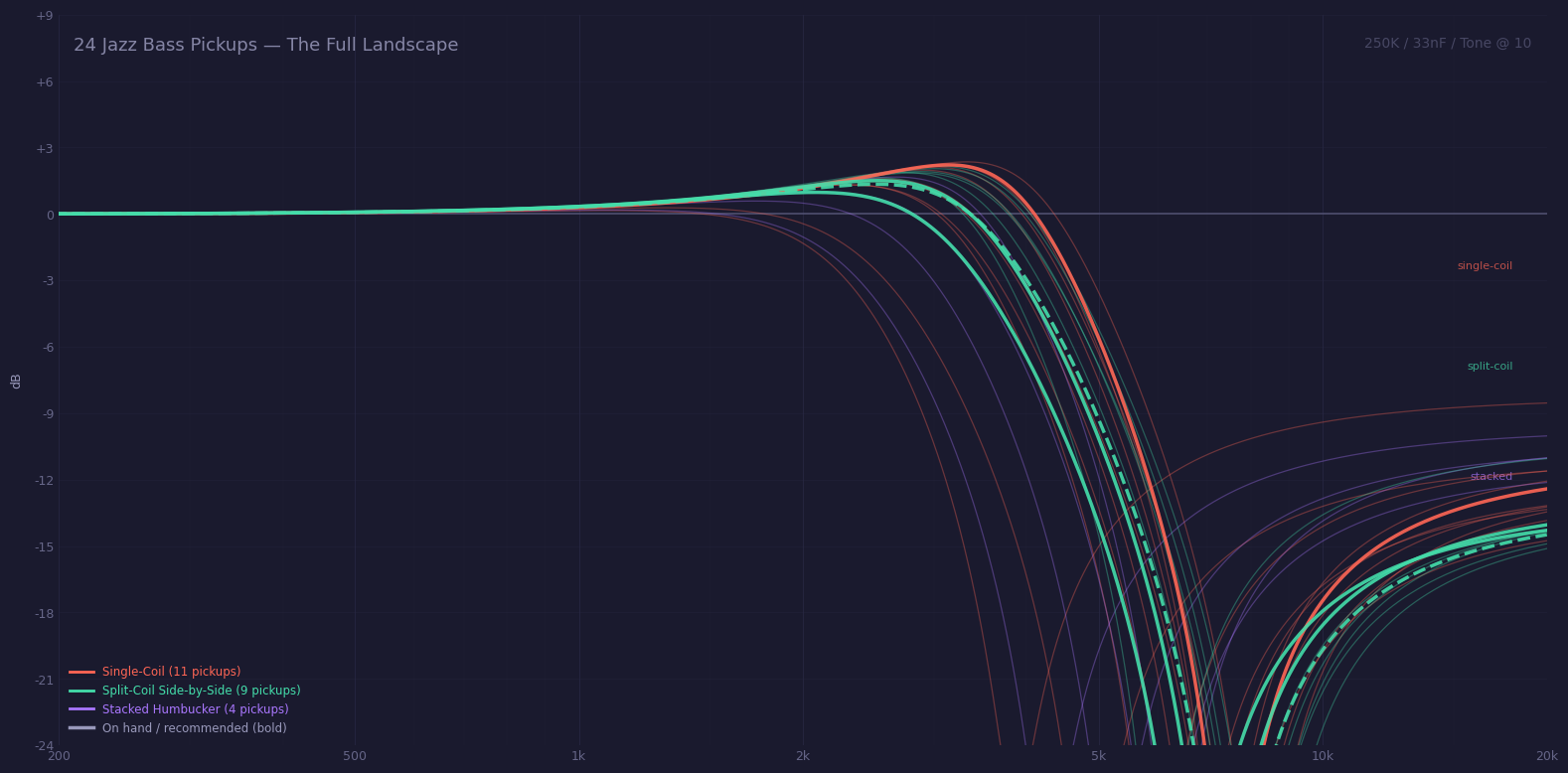
The color tells the story. Single-coils (orange) on top. Split-coils (green) in the middle. Stacked humbuckers (purple) at the bottom.
The spread between architectures is wider than the spread within them. A bright split-coil is still darker than a dark single-coil. You’re choosing an architecture first, a pickup second.
Architecture matters more than DC resistance
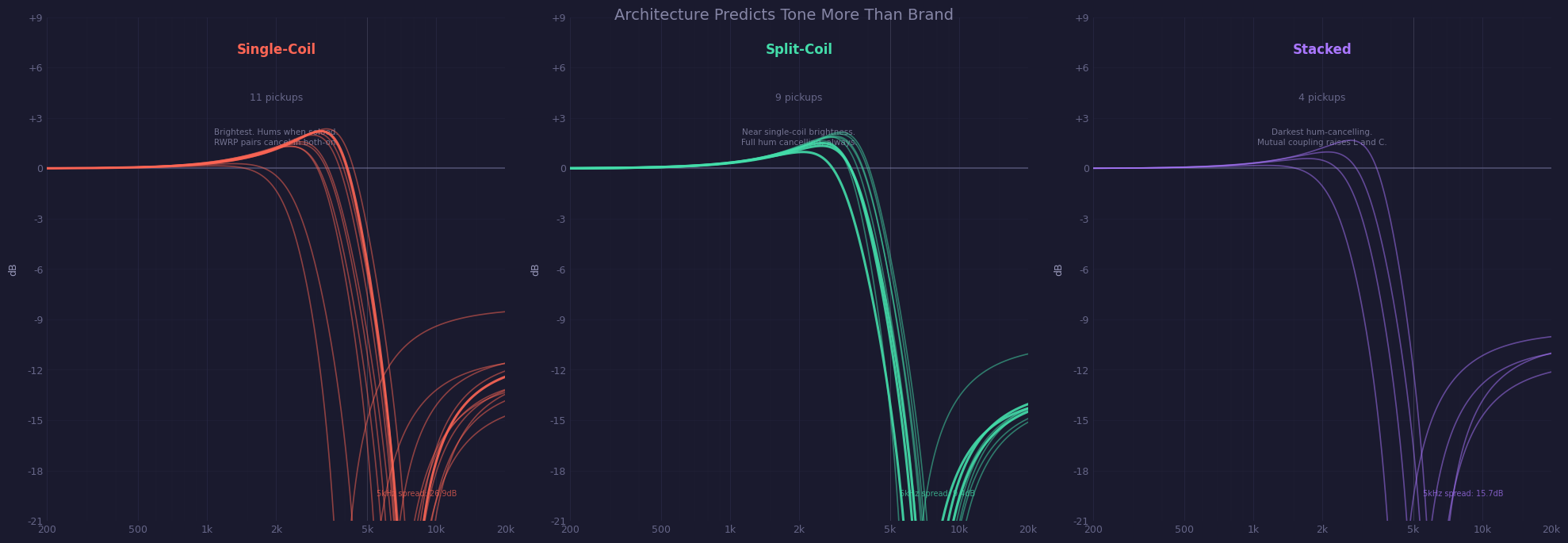
Single-coil. Brightest, widest variation. But they hum when soloed. In a studio, that 60Hz is always there.
Split-coil (side-by-side). Each coil senses two strings, wired in hum-cancelling series. Brightness ranges from “almost single-coil” (DiMarzio Model J, SD Apollo) to “genuinely warm” (Fralin Split Jazz, Ultra Jazz). Silent in every position. The spread within this group is wide. Architecture alone doesn’t predict where a split-coil lands.
Stacked humbucker. Two coils stacked vertically. The mutual coupling raises effective inductance and capacitance, pushing the resonant peak lower. Even a low-impedance stacked design (DiMarzio Area J, 7.8kΩ) ends up darker than most split-coils.
The character map
This is the chart I keep coming back to.
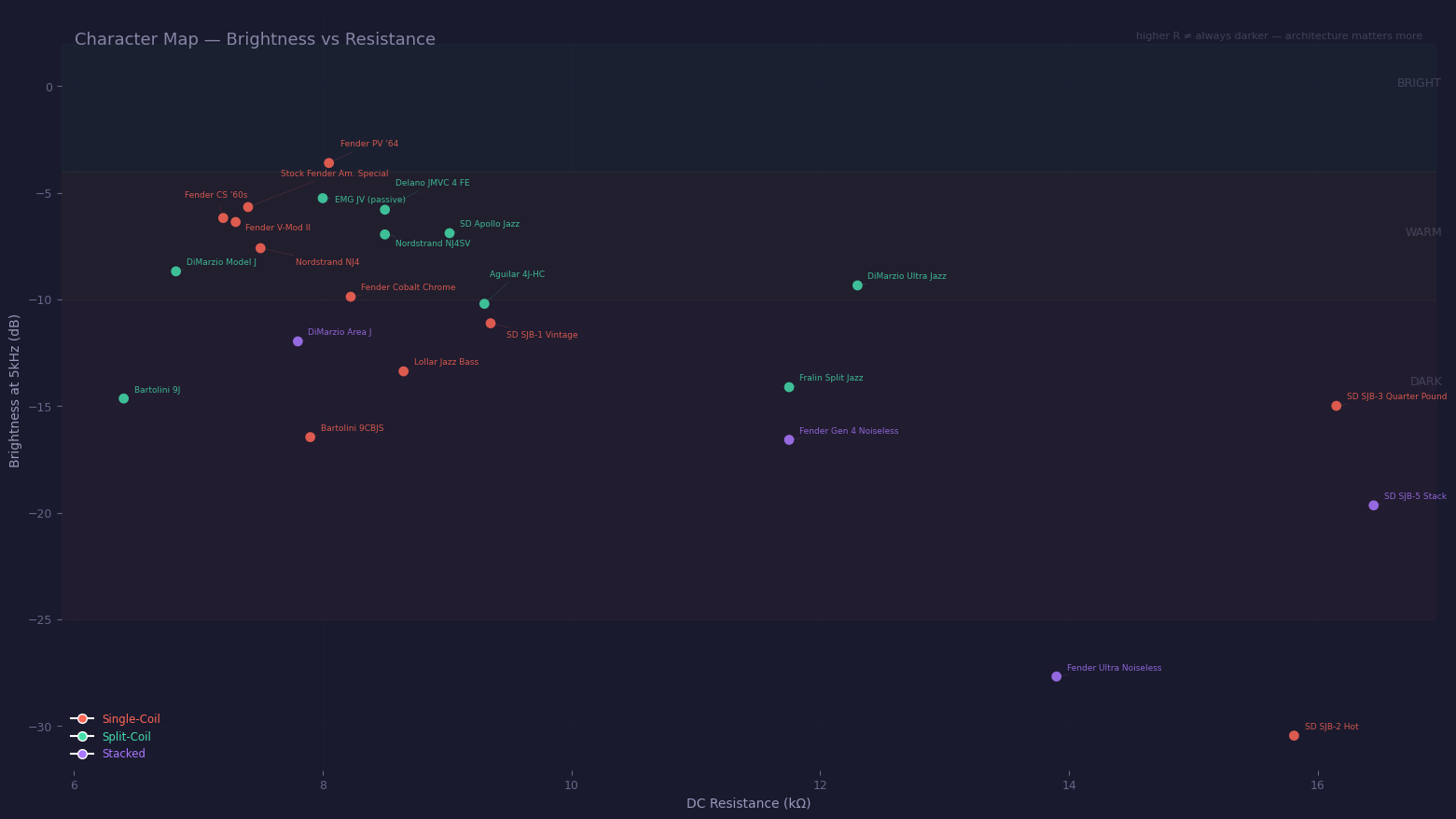
If DC resistance determined tone, all the dots would sit on one diagonal line. They don’t. The clusters follow architecture, not resistance.
DiMarzio Ultra Jazz: 12.3kΩ. DiMarzio Area J: 7.8kΩ. The Area J has lower resistance but similar brightness. Stacking raises L and C in ways resistance doesn’t predict. Meanwhile the Aguilar 4J-HC at 9.3kΩ is brighter than both despite lower output, because its split-coil architecture keeps inductance moderate.
The SD SJB-3 Quarter Pound (16kΩ, 6.7H measured) and SD SJB-2 Hot (15.8kΩ, ~6.75H) have nearly identical resistance. But the SJB-3’s quarter-inch pole pieces and lower capacitance push its resonant peak higher. More aggressive, more present. Same resistance class, different tone.
“Higher output pickups are darker” is only true within the same architecture. Across architectures, it breaks down completely.
The shootout: four contenders
For this build (Fender American Special, studio DI, TI flatwounds), four pickups I either own or plan to order.
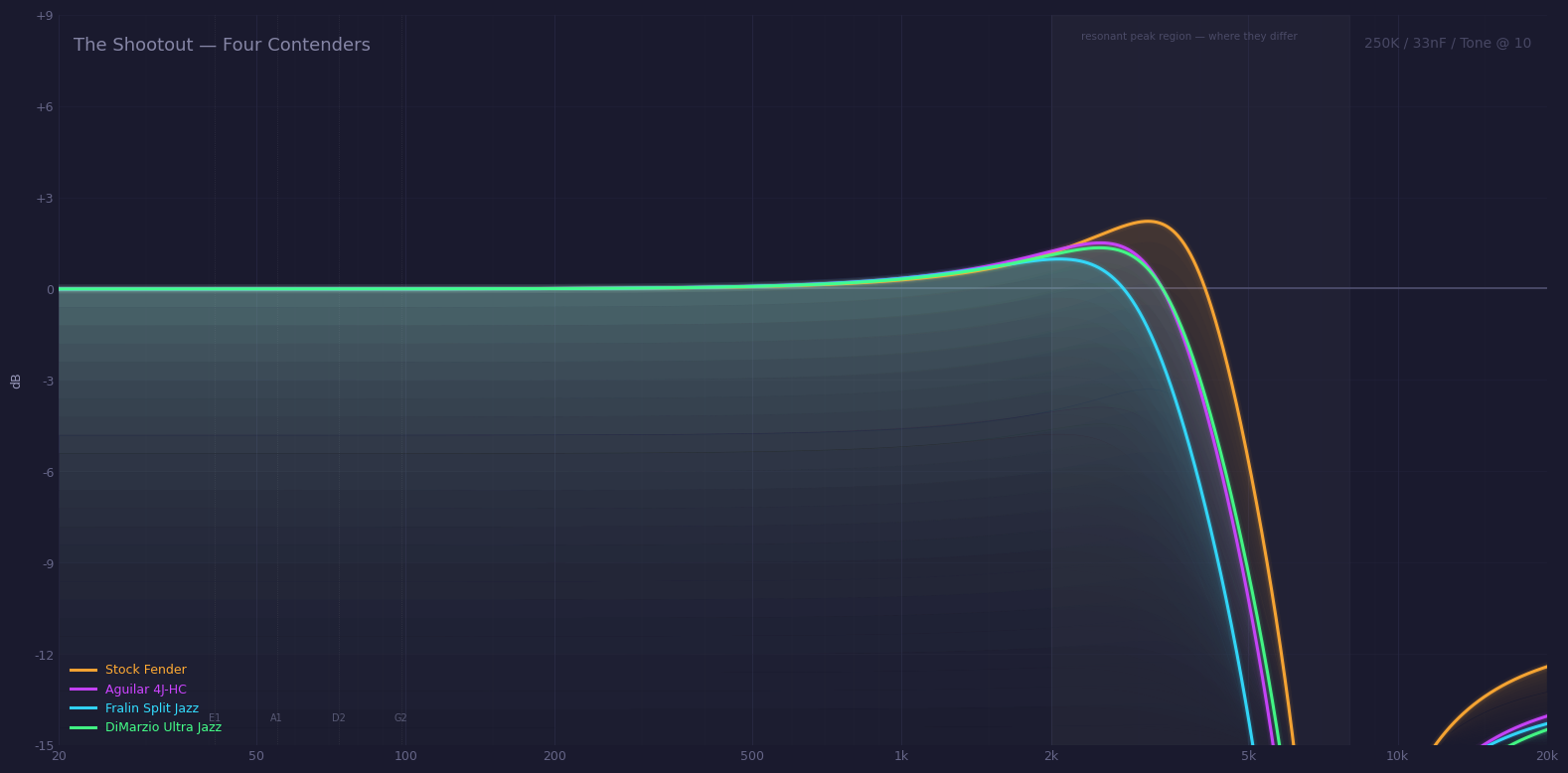
Below the bass fundamentals, identical. The separation starts around 1.5kHz.
- Stock Fender. Brightest. Single-coil. Hums when soloed.
- DiMarzio Ultra Jazz. Brightest hum-cancelling, but close. DiMarzio’s tone guide rates it Treble 7.0, highest of their J-bass hum-cancelling line. The hybrid magnet (Alnico 5 + ceramic) likely keeps inductance lower than the 12.3kΩ DCR would predict. Estimated 3.8H.
- Aguilar 4J-HC. Less than 1dB behind the Ultra Jazz. Moderate inductance (3.8H est.), Alnico 5. Balanced, articulate. Close enough that real-world differences may come down to output (250mV vs ~180mV) more than frequency response.
- Fralin Split Jazz. Warmest. Higher inductance from heavy winding. With TI flats already dark, that stacks a lot of warmth.
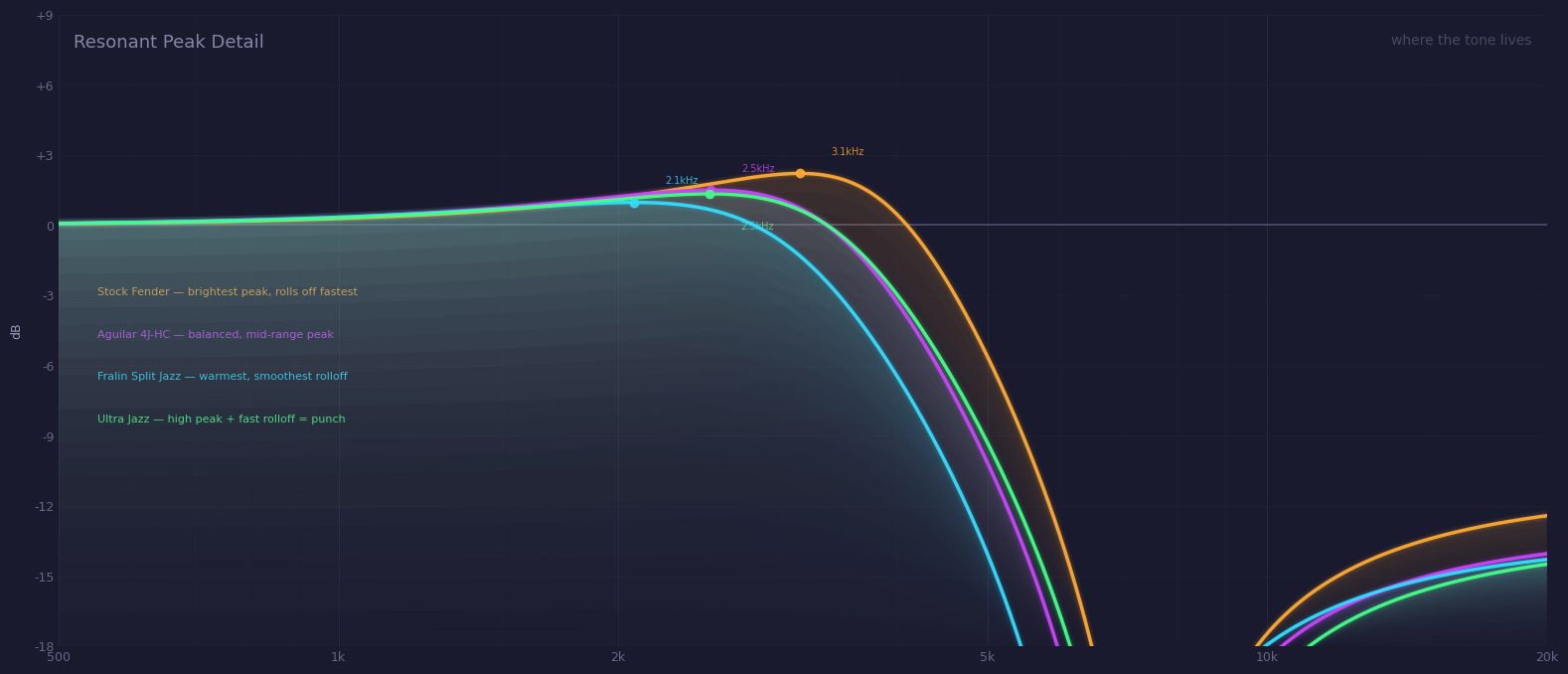
Zoomed in: the stock Fender peaks highest and earliest. Classic shimmer. The Ultra Jazz and Aguilar track close together through the upper mids, within 1dB. The Fralin rolls off earlier and smoother.
Tone caps
The cap only matters when you turn the tone knob down. At 10, every cap value is identical.
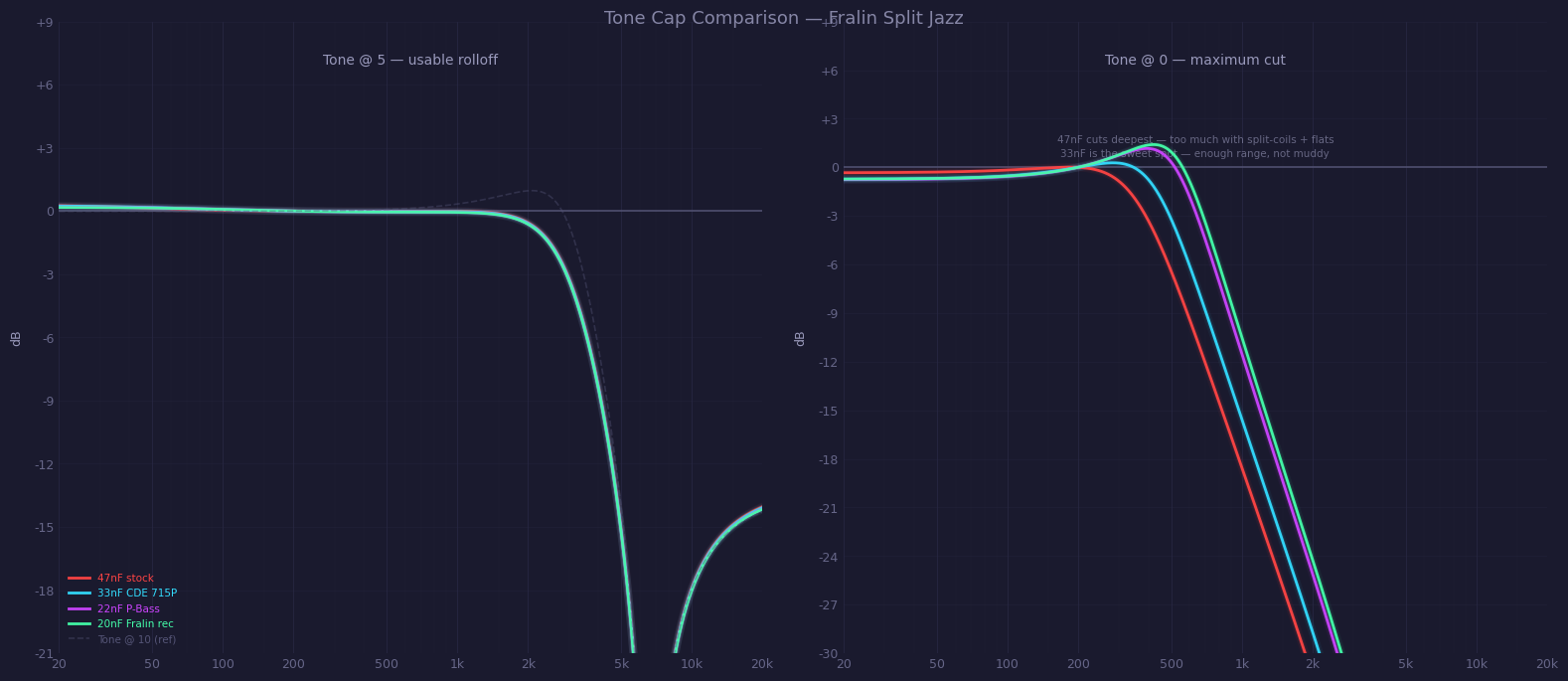
At tone 5, differences are subtle. The 47nF (stock value) cuts earliest. With split-coil pickups plus flatwounds, it removes too much. The 33nF gives a more controlled rolloff.
At tone 0, the gap widens. 47nF kills everything above 1kHz. 33nF is less aggressive. More usable range before it goes dark.
Greasebucket vs standard tone
The Greasebucket adds a 4.7kΩ resistor in series with the tone cap, plus a 100nF cap from wiper to junction. At tone 10, it does nothing.
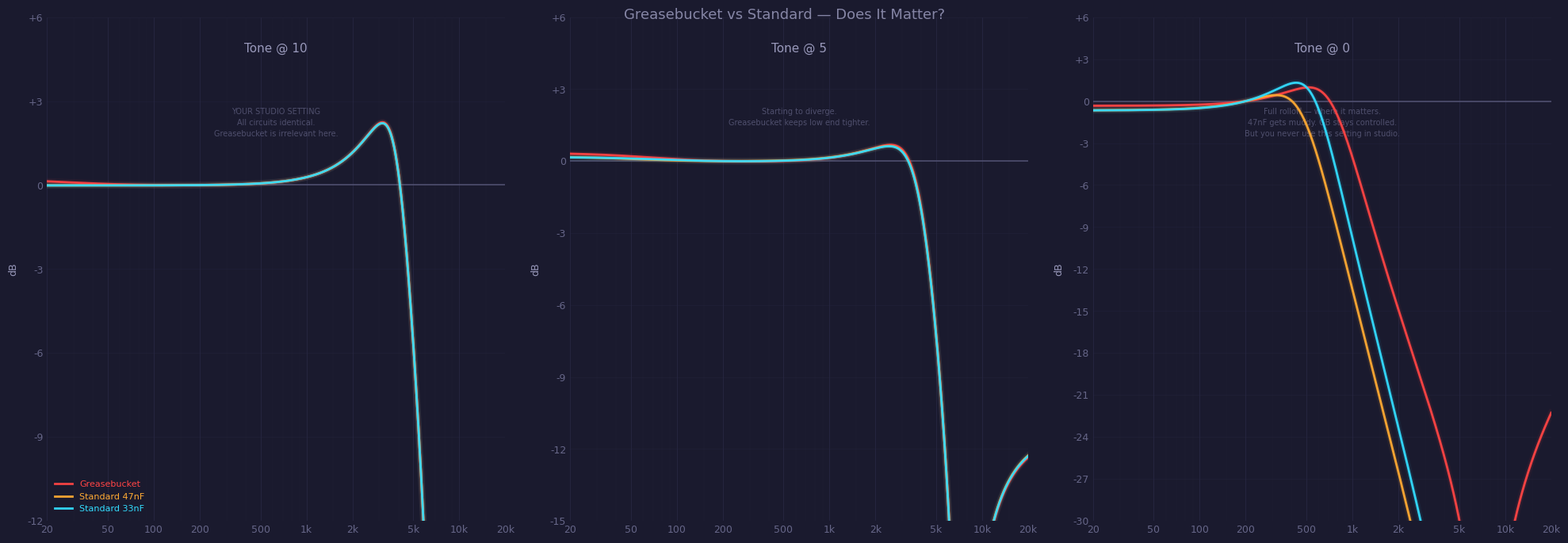
It earns its keep at tone 0. A standard 47nF circuit lets bass frequencies rise as treble drops. That’s the “woolly” sound. The 4.7kΩ resistor limits the minimum impedance to ground, keeping the low end tight.
The American Special came with one stock. Three extra components, completely transparent when not engaged. Insurance against mud.
Series mode
Push-pull on the volume pot. Both pickups in series instead of parallel. Doubles effective inductance, shifts the resonant peak lower, adds 3-6dB of mid-range presence. A 220kΩ pad resistor (auto-engaged by the DPDT switch) tames the peak into something musical.
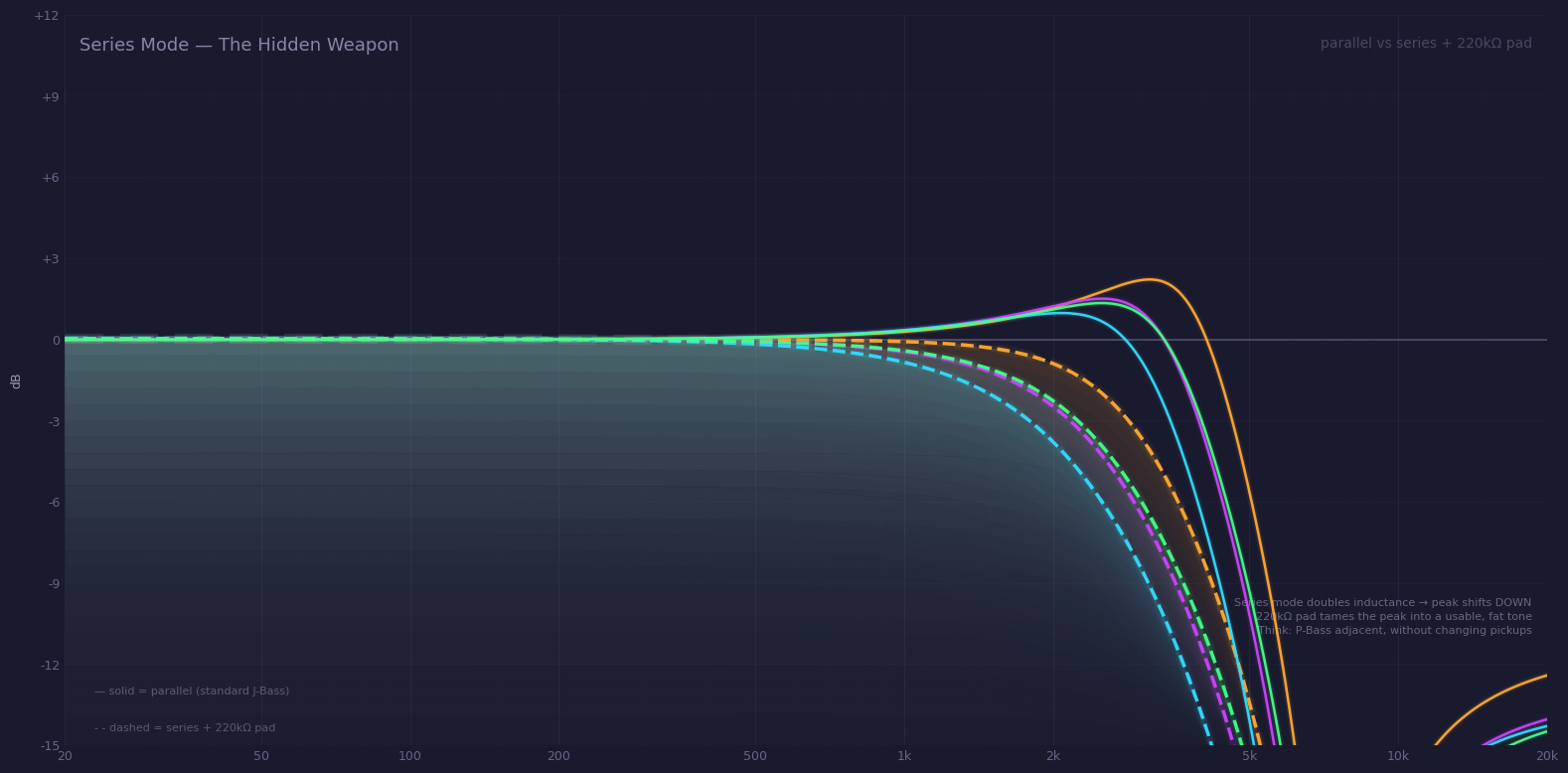
Parallel is classic J-Bass. Scooped mids, glassy highs. Series is P-Bass territory. Fat, mid-forward, punchy. Two instruments from one pair of pickups.
Treble bleed: skip it
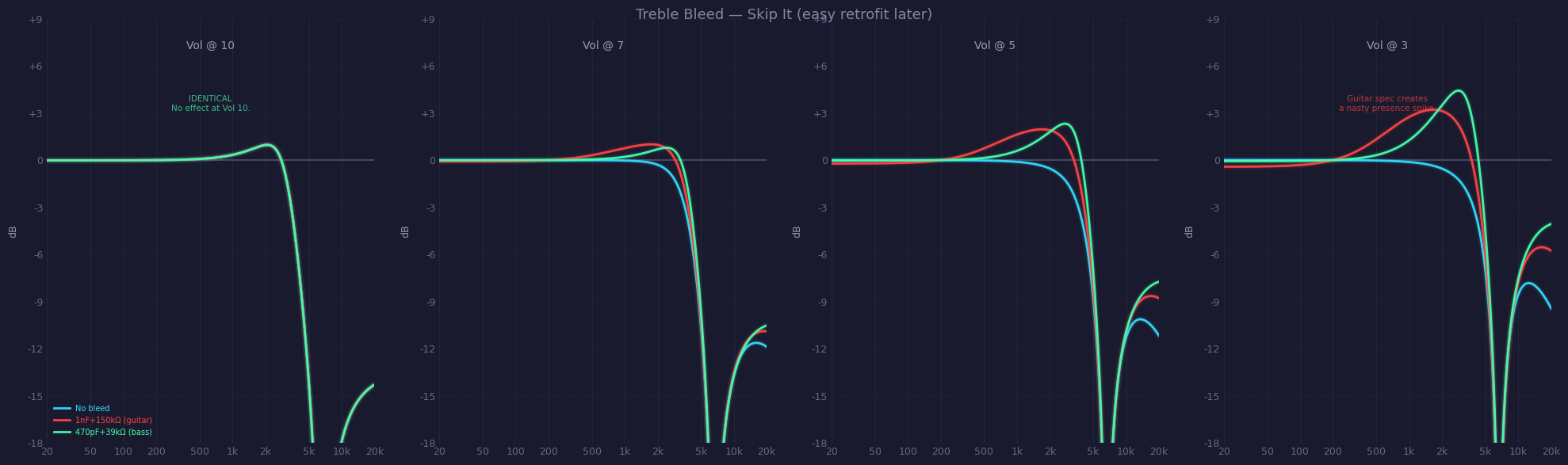
At volume 10 (primary studio setting), all options are identical. At volume 7, differences under 1dB. At volume 3, a guitar-spec network (1nF + 150kΩ) creates a honky presence spike. Bass doesn’t need it. Skip it. Two-minute retrofit if you ever want it live.
Pot values: 250K vs 500K
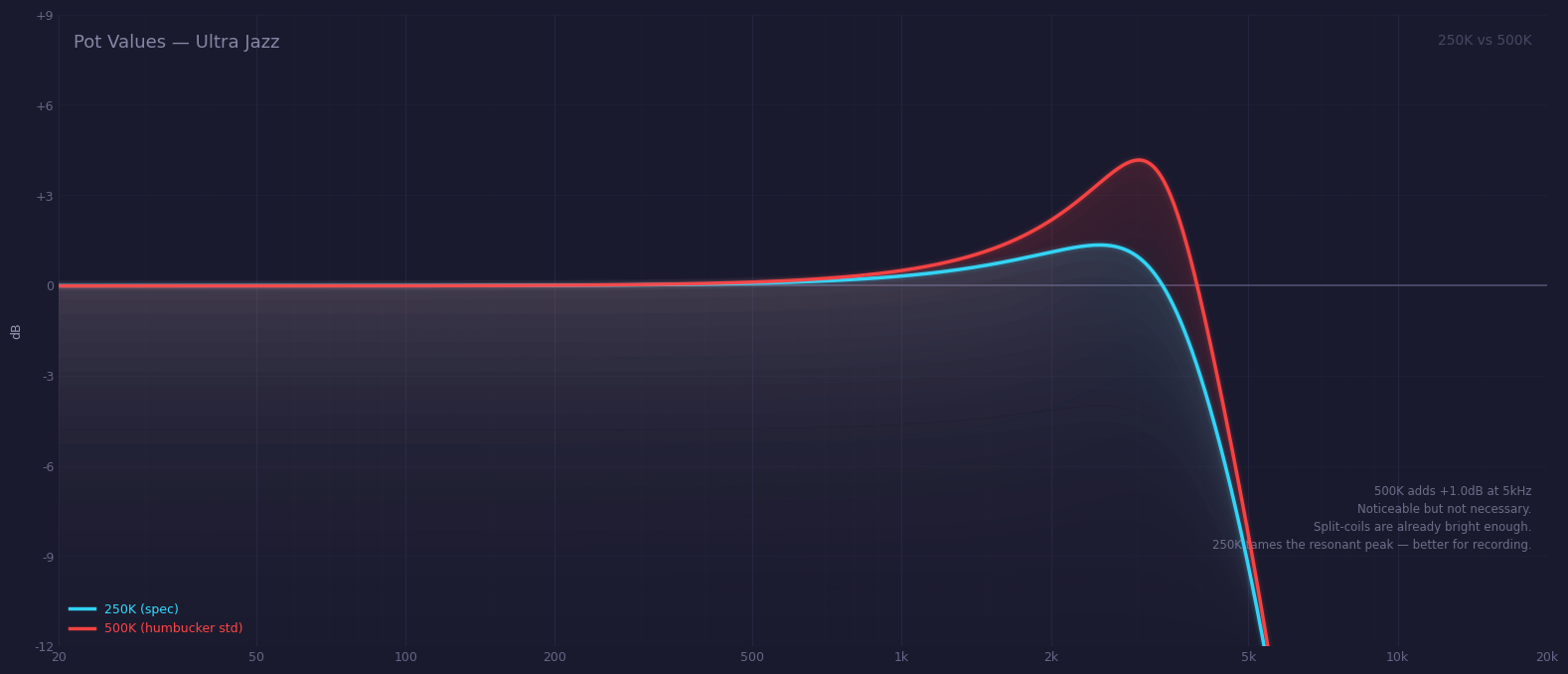
500K adds a small brightness bump at the resonant peak. Split-coils already deliver more brightness than stacked designs. No need to push it. 250K tames the peak into something smooth. That’s what you want going into a DAW.
Before and after
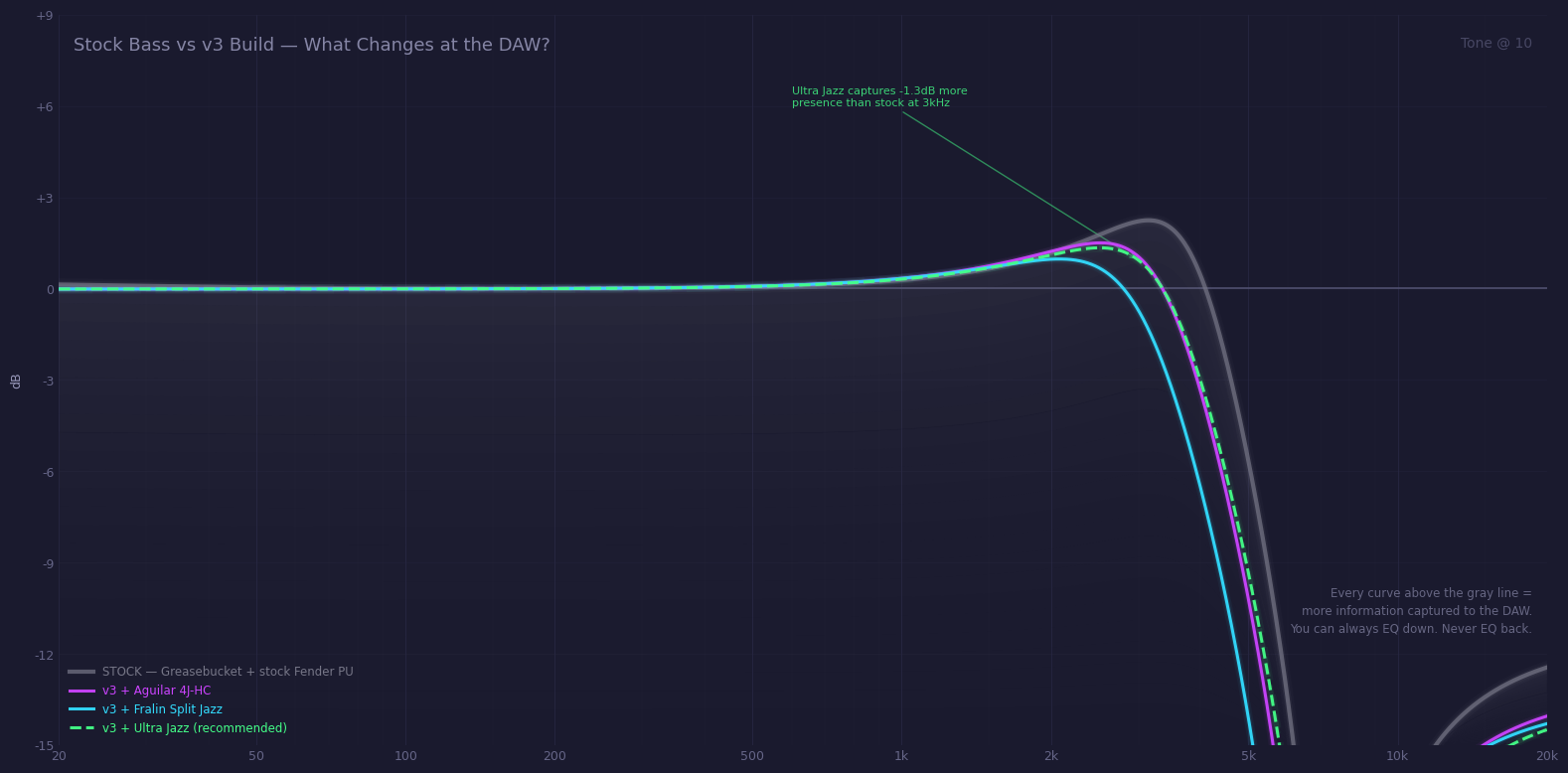
Gray line: stock single-coils through the factory Greasebucket.
Ultra Jazz and Aguilar are nearly identical through the upper harmonics, within 1dB at 5kHz. The Ultra Jazz has more output. The Aguilar is cleaner. The Fralin rolls off earlier. All three eliminate the 60Hz problem.
Capture everything, sculpt later. You can EQ down in the mix. You can’t EQ back information that was never recorded.
The build
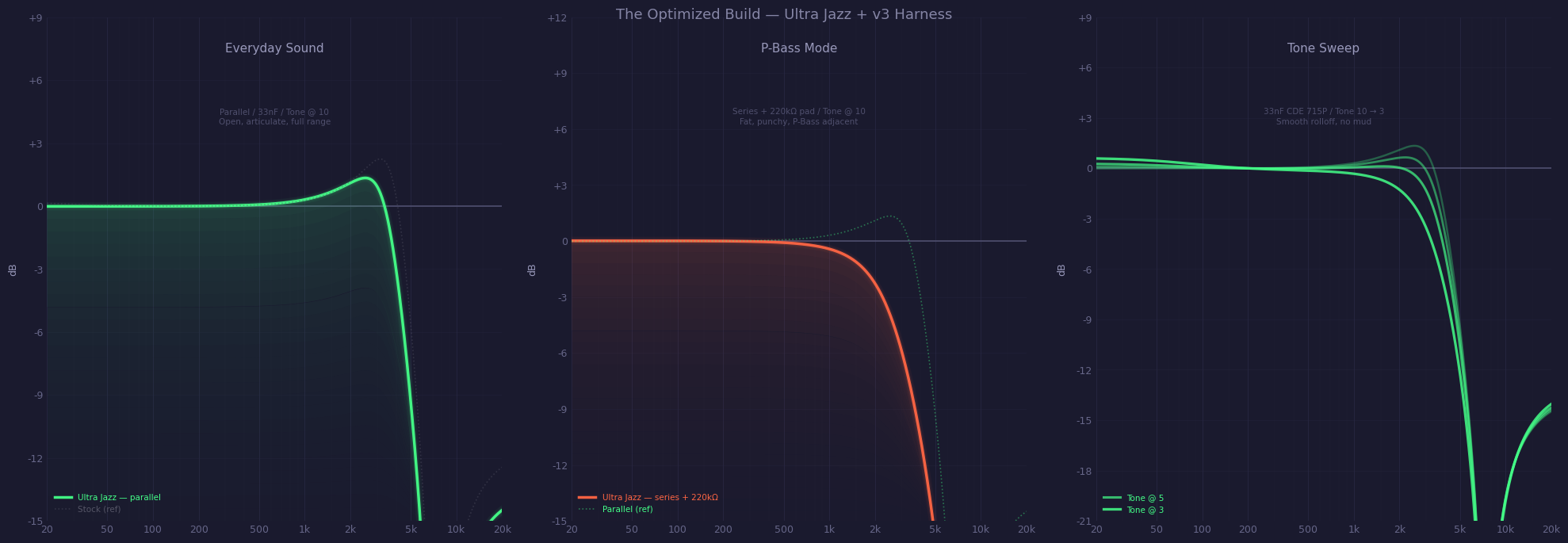
Everyday. Ultra Jazz in parallel, tone at 10. Punchy, articulate, zero hum. More output than the Aguilar, similar brightness.
P-Bass mode. Series with 220kΩ pad. Fat, thick, doubled inductance. A different instrument.
Tone sweep. Rolling from 10 to 3 with the 33nF cap. Smooth, controlled. No mud.
Three knobs. Two modes. Every decision backed by simulation instead of forum mythology, with one caveat below.
What this is and isn’t
A simulation, not a measurement rig. The architecture groupings (single-coil brightest, split-coil middle, stacked darkest) are robust. Rankings within each group are less certain.
What’s solid. DC resistance from manufacturer spec sheets. Fender inductance published by Fender. SD SJB-3 Quarter Pound independently measured at 6.72H by antigua (Echoes of Mars). Lollar bridge measured at 4.88H by the same source.
What’s estimated. DiMarzio, Aguilar, Fralin, Nordstrand, Bartolini, EMG, and Delano don’t publish inductance. The Aguilar is estimated at 3.8H from a standard L/R ratio. The Ultra Jazz estimate (also 3.8H) is informed by DiMarzio’s own tone guide ratings across their three hum-cancelling J-bass pickups:
| Model J | Area J | Ultra Jazz | |
|---|---|---|---|
| Architecture | Split-coil | Stacked | Split-coil |
| DCR | 6.82kΩ | 7.80kΩ | 12.3kΩ |
| Output | 150mV | 155mV | 250mV |
| Treble | 5.5 | 4.5 | 7.0 |
The Ultra Jazz has highest DCR but also highest treble rating. DiMarzio’s own copy: “even with a relatively high DC resistance figure, the Ultra Jazz has very strong, percussive highs.” The hybrid magnet (Alnico 5 rods + ceramic bar) likely reduces inductance per ohm compared to pure Alnico or ceramic designs. A standard L/R estimate would give ~5H. The tone ratings suggest something closer to 3.5-4.0H.
These estimates carry ±15-20% uncertainty. A 0.5H shift changes the ranking between Ultra Jazz and Aguilar.
What’s missing. String/body resonance, magnetic pull, nonlinear effects of string vibration amplitude, subjective character. The sim captures the passive electronics, where most measurable tonal variation lives in a DI chain. Measurable isn’t everything.
The real test comes when the pickups are in the bass. This tells you what to expect. The wiring guide tells you how to build it.