Jamerson. Laura Lee in Khruangbin. Colin Greenwood on a P-bass. 70s disco from a DI. The bass owns its lane — warm, mid-forward, felt as much as heard. Warmth from 200Hz to 1kHz, controlled presence around 2 to 3kHz, no interest in extended treble for its own sake.
You already know what you want to sound like. The question is which pickup gets you closest — and, two months into playing the one that won, how much the pickup was ever the question.
Four hum-cancelling finalists from the pickup simulation database, mapped across three circuit stages. The pickup that wins depends on the circuit you build. The circuit, it turned out, moves the sound more than the pickup does.
The four
Fralin Split Jazz
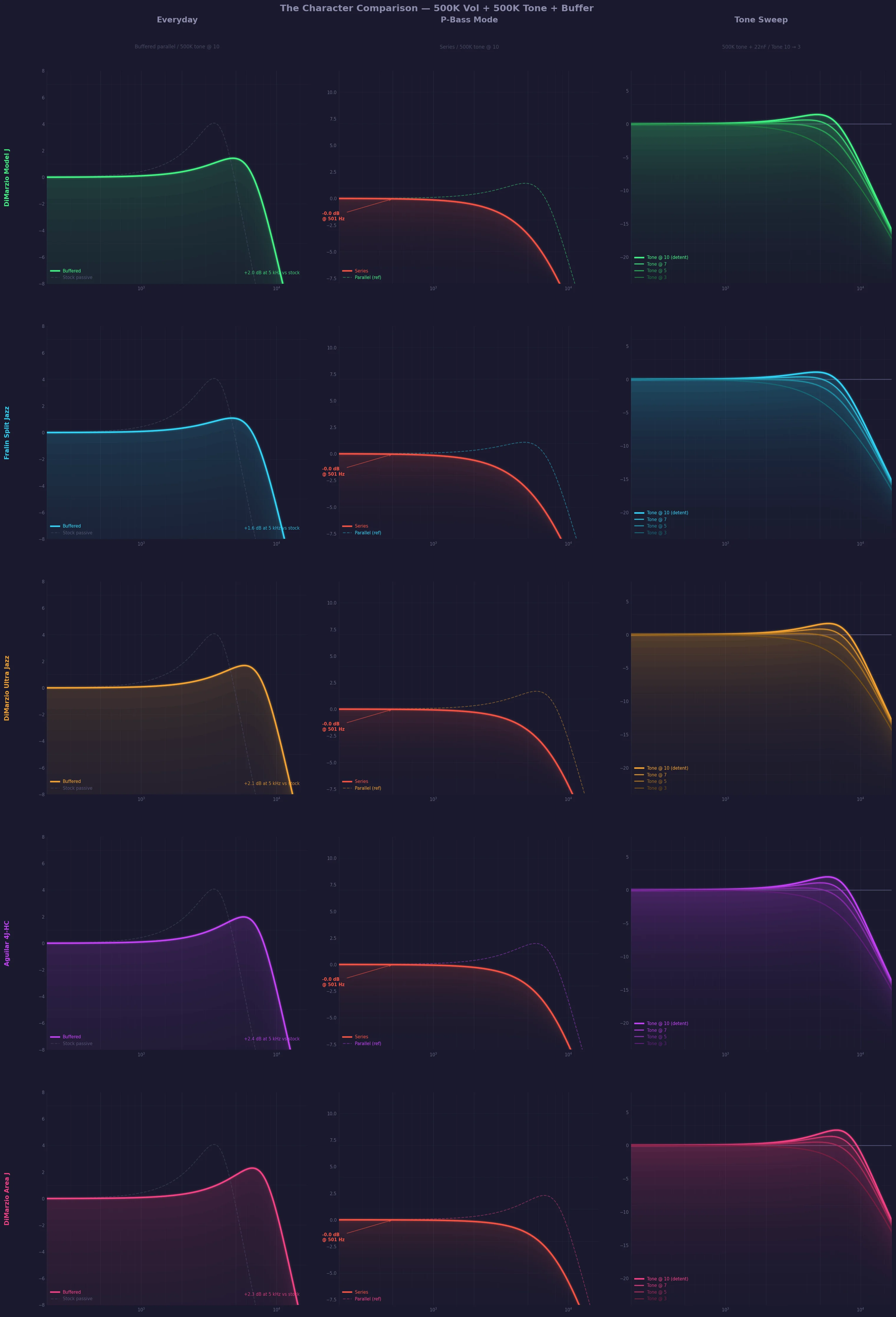
Split-coil, 11.75k, and the one in the bass. Handwound, scatter-wound coils, wax potted. The sim carries it at 4.8H, the highest inductance of the four, and gives it the most rolled-off top of the group. That 4.8 is an estimate from the DCR, and Fralin winds this pickup with 43 AWG rather than the 42 the estimate assumes — thinner wire, more ohms per turn — so the real figure is probably nearer 4H.
On the bench it barely reads that way. Through the stock harness, level-matched against the stock Fender single-coils on the same riff, the Fralins landed within 2dB above 3kHz with both pickups on, with a touch more growl at 1–1.5kHz. Only the soloed neck was duller: 2–3dB down above 3kHz. Hum-free is darker, and the difference is smaller than the forum consensus.
The hum difference is not small. A stock single-coil soloed puts about −70dBrms of hum on the line. The Fralins in a shielded cavity: −89dBrms, any position, soloed included.
Series mode takes it deepest of the four, 9.6H effective. Parallel growl collapses into P-bass thump.
DiMarzio Ultra Jazz
Split-coil, hybrid magnet — Alnico 5 rods plus a ceramic bar. 3.8H. This is the pickup Laura Lee plays in Khruangbin, and the Khruangbin tone is the tell: even across the spectrum, no presence peak to fight and no scoop to fill. Flats and foam put you most of the way there before you touch a knob.
The hybrid magnet flattens the response, so any filter you add starts from a flatter floor. Series mode shifts less than the Fralin’s — it starts brighter, so parallel and series sit closer together.
Aguilar 4J-HC
The one already on the bench before this project started. 3.8H, 9.3k. Flattest overall response of the four in the sim, and — through the stock harness, same riff, level-matched — the brightest of the three pickups actually tested: +2 to +3dB over the stock single-coils at 1.5–5kHz, more above. Numbers that size sit within what pickup height and a different day’s plucking can move, so read them as “not darker,” not as a ranking.
It sounds like your hands and your strings more than it sounds like a pickup. Drop it in and it works without any thought about the circuit.
DiMarzio Area J
Closest to a single-coil in the group: 3.2H, Alnico 2, the lowest inductance and lowest magnetic pull. Split-coil side-by-side, confirmed by DiMarzio tech support — the J-bass version isn’t stacked like the guitar Area pickups. It stays bright even in series at 6.4H effective. If the goal is the warm, mid-forward character above, the Area J is the furthest from it.
Three stages
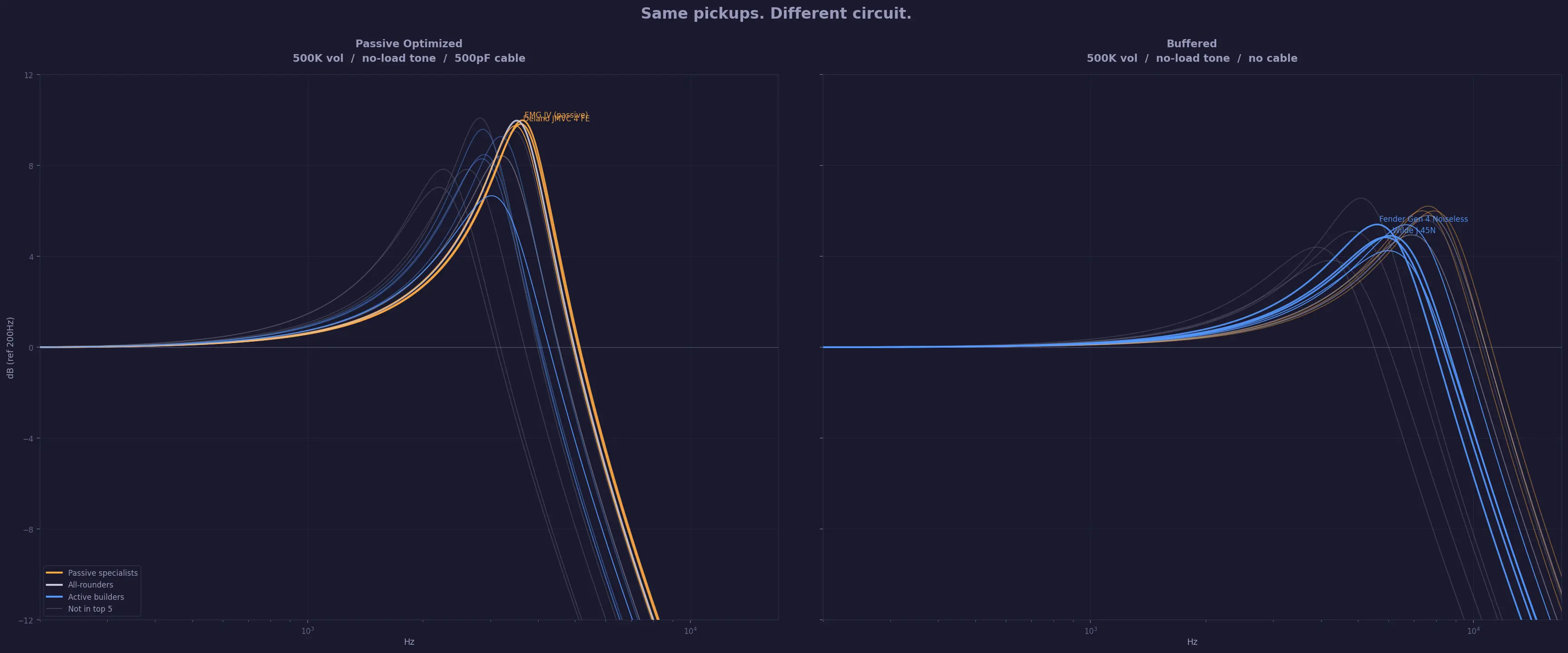
Remove the cable and the high end reorders top to bottom. Which would be the headline, except a bass makes almost nothing up where the reordering happens.
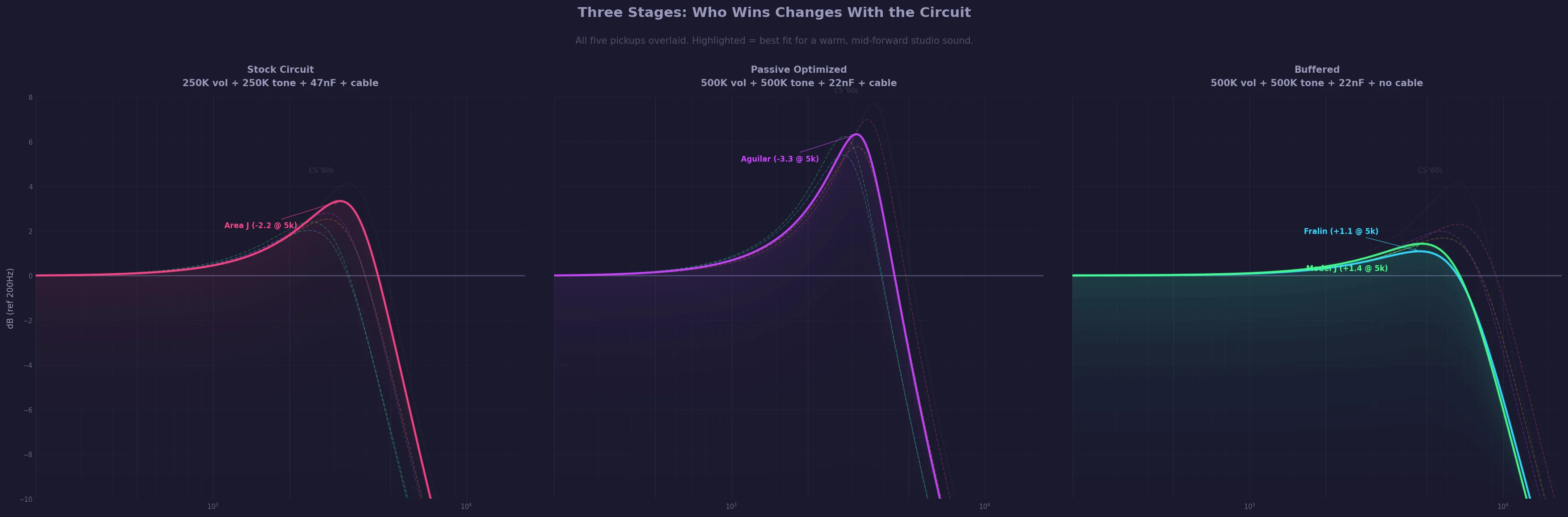
The Fralin’s high inductance was being crushed by cable loading; it climbs to the top once the cable comes off. The Area J barely moves — it was already bright through a cable.
| Pickup | Stock | Buffered | Total gain at 5kHz |
|---|---|---|---|
| Fralin Split Jazz | -6.8 dB | +4.8 dB | +11.7 dB |
| Aguilar 4J-HC | -4.4 dB | +4.5 dB | +8.9 dB |
| Ultra Jazz | -4.2 dB | +3.9 dB | +8.1 dB |
| Area J | -2.2 dB | +3.4 dB | +5.7 dB |
Those gains assume a 500pF cable — a long or budget run. Through a short quality cable (~200pF, 3m) the buffer’s gain at 5kHz shrinks to 0–2dB across the board. The buffer isn’t buying treble; it’s buying the same treble regardless of which cable you grab.
What the circuit doesn’t change: magnetic pull, eddy currents, how the coil behaves under hard playing. Those are physical properties. That’s what you’re actually choosing when you pick a pickup.
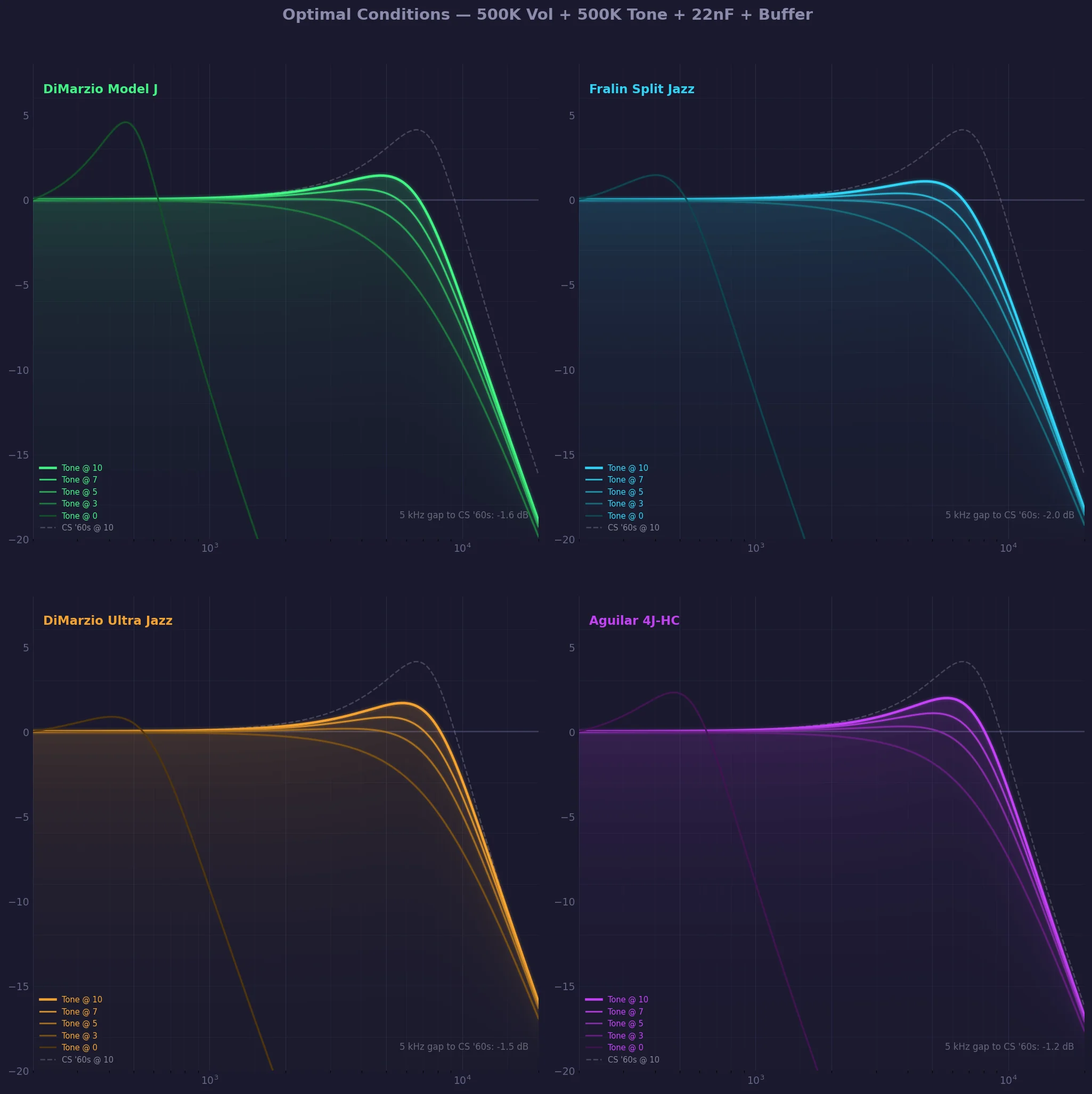
Each pickup’s resonant peak with the tone slot open, then with the bark cap engaged; CS ’60s single-coil dotted for reference. The Fralin has the widest spread. The lower-inductance pickups throw up less of a peak to move.
Why the rankings invert
Gen 4 Noiseless: #9 passive, #3 buffered. Area J: #2 passive, #14 buffered. Delano: #1 passive, #11 buffered.
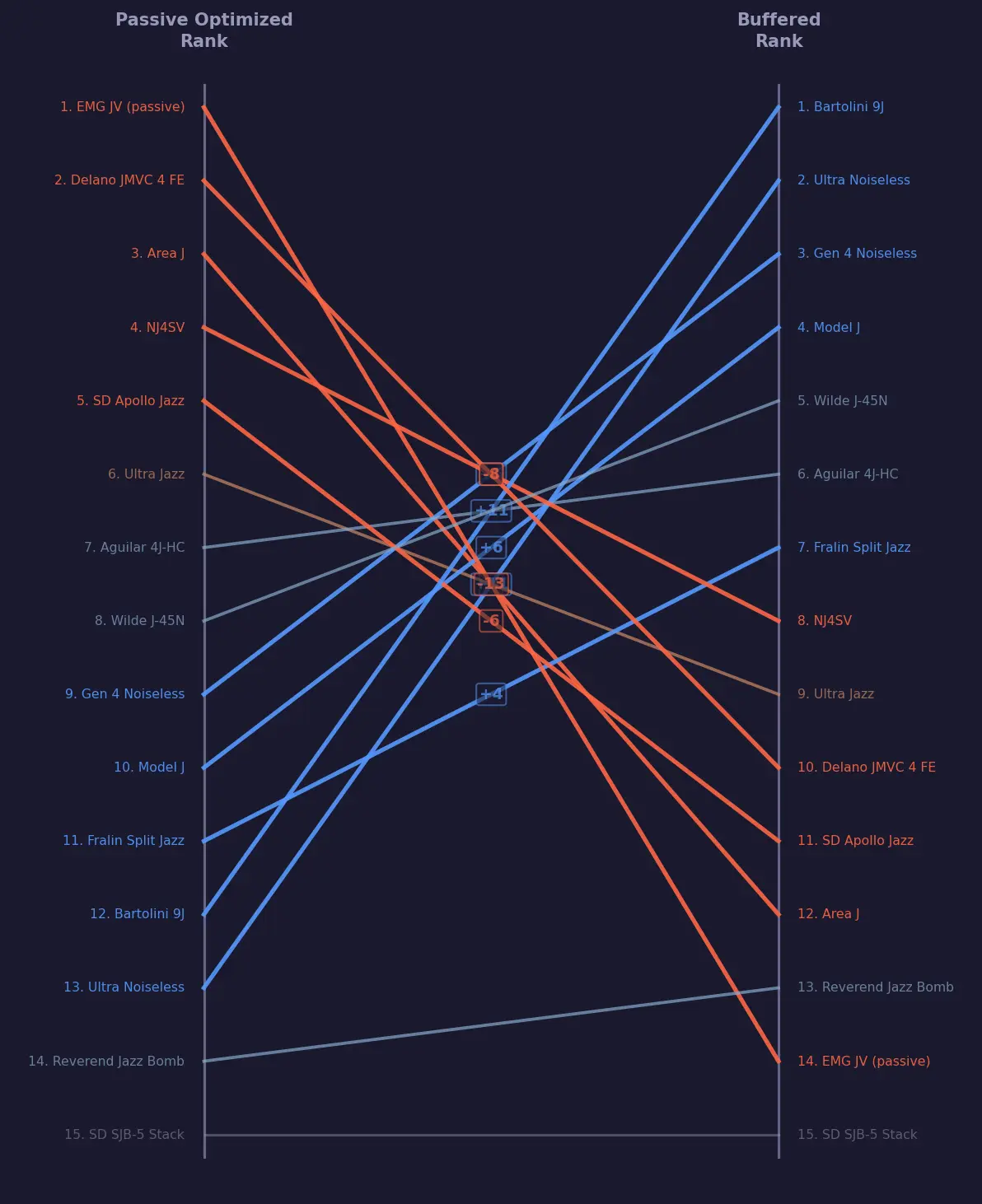
| Pickup | Passive rank | Buffered rank | Movement |
|---|---|---|---|
| Delano JMVC 4 FE | 1 | 11 | -10 |
| Area J | 2 | 14 | -12 |
| EMG JV-HZ | 3 | 13 | -10 |
| Nordstrand NJ4SV | 4 | 9 | -5 |
| SD Apollo Jazz | 5 | 12 | -7 |
| Ultra Jazz | 6 | 8 | -2 |
| Aguilar 4J-HC | 7 | 7 | 0 |
| Wilde J-45N | 8 | 5 | +3 |
| Gen 4 Noiseless | 9 | 3 | +6 |
| Fralin Split Jazz | 10 | 6 | +4 |
High-inductance pickups are suppressed by cable loading. Remove the cable and they open up. Low-inductance pickups were already near their ceiling. The full mechanism is in the tonality guide.
This is a 5kHz story, and a bass doesn’t live at 5kHz. The reorder is real in the sim and nearly inaudible on a held note. What you buy by killing the cable is consistency — the same tone into any cable, on any day.
The harness
Built for the Fralin: 500K volume with a push-pull (parallel/series), 250K MN blend, a no-load Q dial in the tone slot, TRS jack with a phantom-powered buffer on the ring. Full build in the harness guide.
What it did, measured against the stock harness with the same Fralins in the same bass: flat below 1.5kHz, a 4–6dB dip at 2–3.5kHz where the old circuit’s peak used to sit, and +12dB at 6.5kHz where the pickup’s own resonance had been buried under two 250K pots and a tone cap. The pickup swap, through the stock harness, was a 2dB change. The harness swap was 12.
Two months of playing filled in the rest.
The series pull is the control that gets used. Coils stacked, blend centred: roughly +10dB, resonance an octave down, P-bass body, no hum. Pull it for the second bass, push it back for the first.
The Q dial is a switch. 1nF has 57kΩ of reactance at 2.8kHz; a 50kΩ pot in series with it trims the bark, it can’t sweep it. Two voices, open and bark, both usable. Not a dial. The mechanism is in the Q-filter post.
No-load is bright. That +12dB is real, and the attack it puts on a fresh roundwound is more than every room wants. A 250K no-load tone pot goes back into the third hole: at 10 it is exactly the current sound, at 9 to 7 it takes 4–6dB off 3–5kHz, at 0 it’s wool. The bark cap becomes a switch on the push-pull’s spare pole, or leaves.
The buffer sits unused at the desk. Through a 3m cable into a 1MΩ instrument input, tip and ring measure within 2dB of each other. Plugged into a line input by mistake, the passive path lost 10–14dB of top and the buffered path didn’t move. That is the buffer’s whole job: immunity, not tone. Worth having for a long cable, a pedalboard, or a desk with no Hi-Z input. Invisible in a studio with one.
Treble bleed
An earlier version of this post said skip it. Wrong, for this harness.
With no tone load and a 500K pot, the volume knob kills the resonance before it kills the level: at 9 the peak has dropped from +10 to +4.5dB; at 7 it’s gone, while the level is only down 2.4 and 8dB. The volume behaves as a tone control first and a volume second — the “dies after 5% of travel” complaint is this, not a bad pot.
A 1nF ∥ 150kΩ bleed across the volume holds the 3–5kHz band at +4dB at 7 instead of −5, with the level at −3.7 instead of −7.9. It does nothing at 10. Guitar-spec values, because it’s the guitar problem arrived at from the other side: a bright pickup, a big pot, and a resonance the wiper resistance can reach.
The verdict
| Warmth | Range | Simplicity | |
|---|---|---|---|
| Fralin Split Jazz | #1 | #1 | #4 |
| Ultra Jazz | #2 | #3 | #2 |
| Aguilar 4J-HC | #3 | #4 | #1 |
| Area J | #4 | #2 | #3 |
Warmth here isn’t 5kHz brightness. It’s how deep series mode goes and how far the tone slot can move the peak. High-inductance pickups win differently here than in the brightness ranking.
Fralin wins warmth and range. The pickup that’s in the bass, and staying.
Aguilar wins simplicity — drop it in, it works. Ultra Jazz for the Fender heritage sound — flats and compression put you in Motown territory.
On a sustained note the Fralin and Aguilar sit within 0.2dB of each other — what you hear between them is character, not level.
If hum isn’t a problem for you, keep the single-coils and spend the money on the harness. If it is, any of the top three plus the harness gets closer to the target than any pickup alone.