I simulated 27 Jazz Bass pickups to map the landscape. That narrowed the field to four. Now the question changes — not which pickup wins, but what circuit makes each hum-cancelling pickup compete with the best single-coil?
The answer is a no-load tone pot.
The four contenders
For this build (Fender American Special, studio DI, TI flatwounds), four pickups I either own or plan to order.
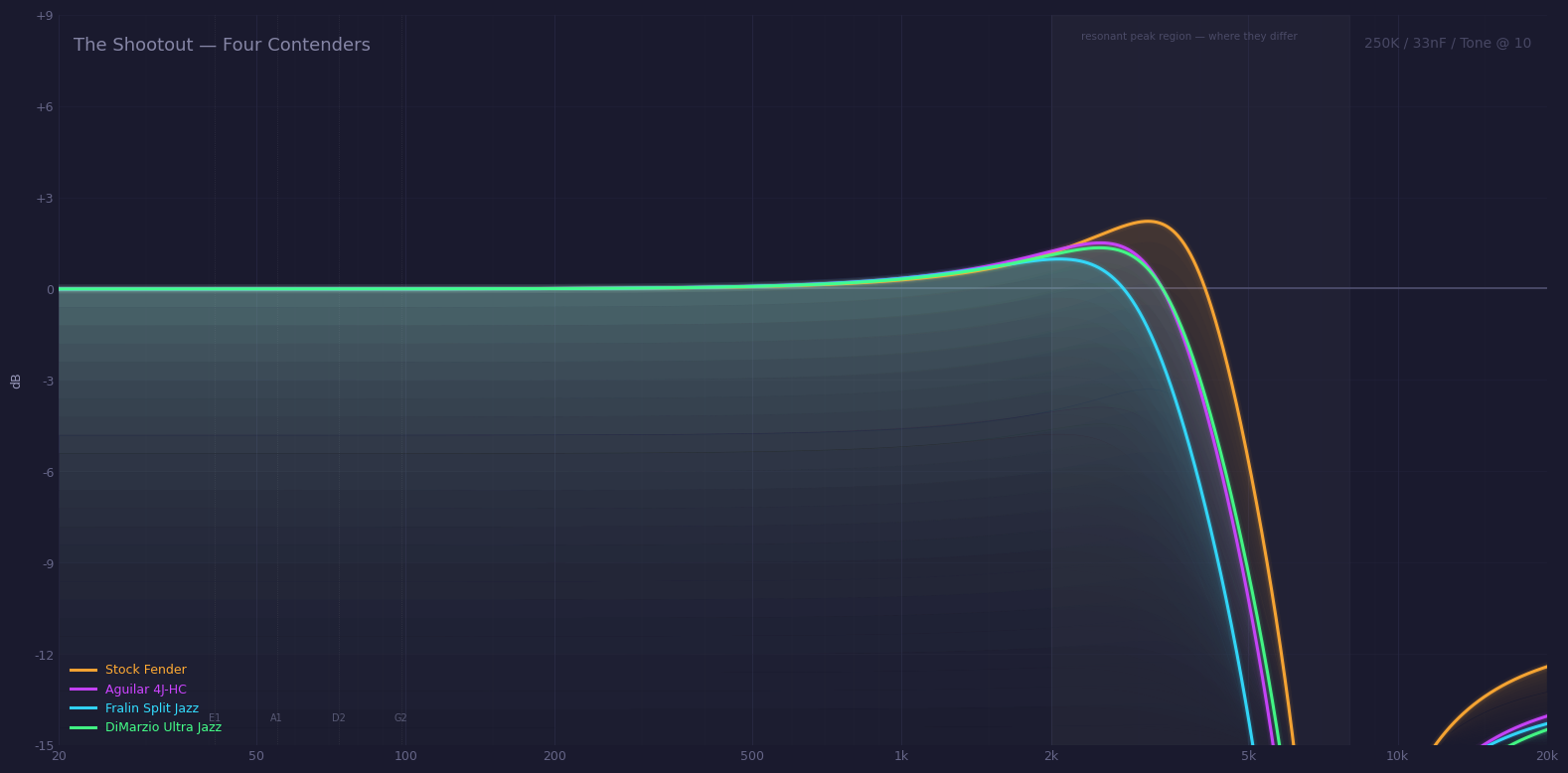
Below the bass fundamentals, identical. The separation starts around 1.5kHz.
- Stock Fender. Brightest of the four. Single-coil. Hums when soloed.
- DiMarzio Ultra Jazz. Brightest hum-cancelling option. DiMarzio’s tone guide rates it Treble 7.0, highest of their J-bass hum-cancelling line. The hybrid magnet (Alnico 5 + ceramic) likely keeps inductance lower than 12.3kΩ would suggest. Estimated 3.8H.
- Aguilar 4J-HC. Tracks close to the Ultra Jazz through the upper mids. Similar estimated inductance (3.8H), similar brightness. Real-world differences may come down to output level (250mV vs ~180mV) more than frequency response.
- Fralin Split Jazz. Warmest. Higher inductance from heavy winding. With TI flats already dark, that stacks a lot of warmth.
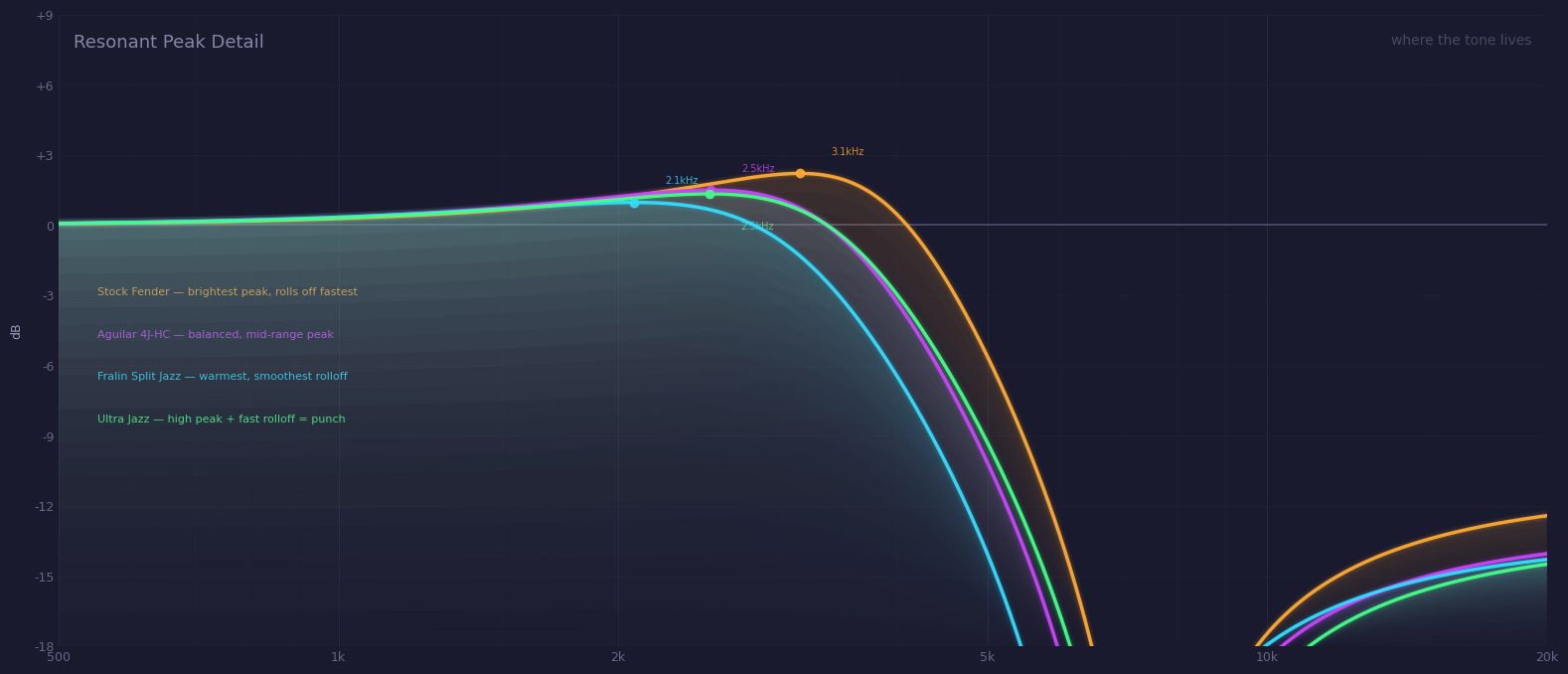
The stock Fender peaks highest and earliest. The Ultra Jazz and Aguilar track together through the upper mids. The Fralin rolls off earlier and smoother.
The no-load tone pot
This is the unlock.
A CTS no-load pot has a detent at 10 that physically disconnects from the circuit. Infinite impedance. Like having no tone pot at all. Below the detent, it’s a normal 250K sweep. Best of both: maximum brightness wide open, full tone control when you need it.
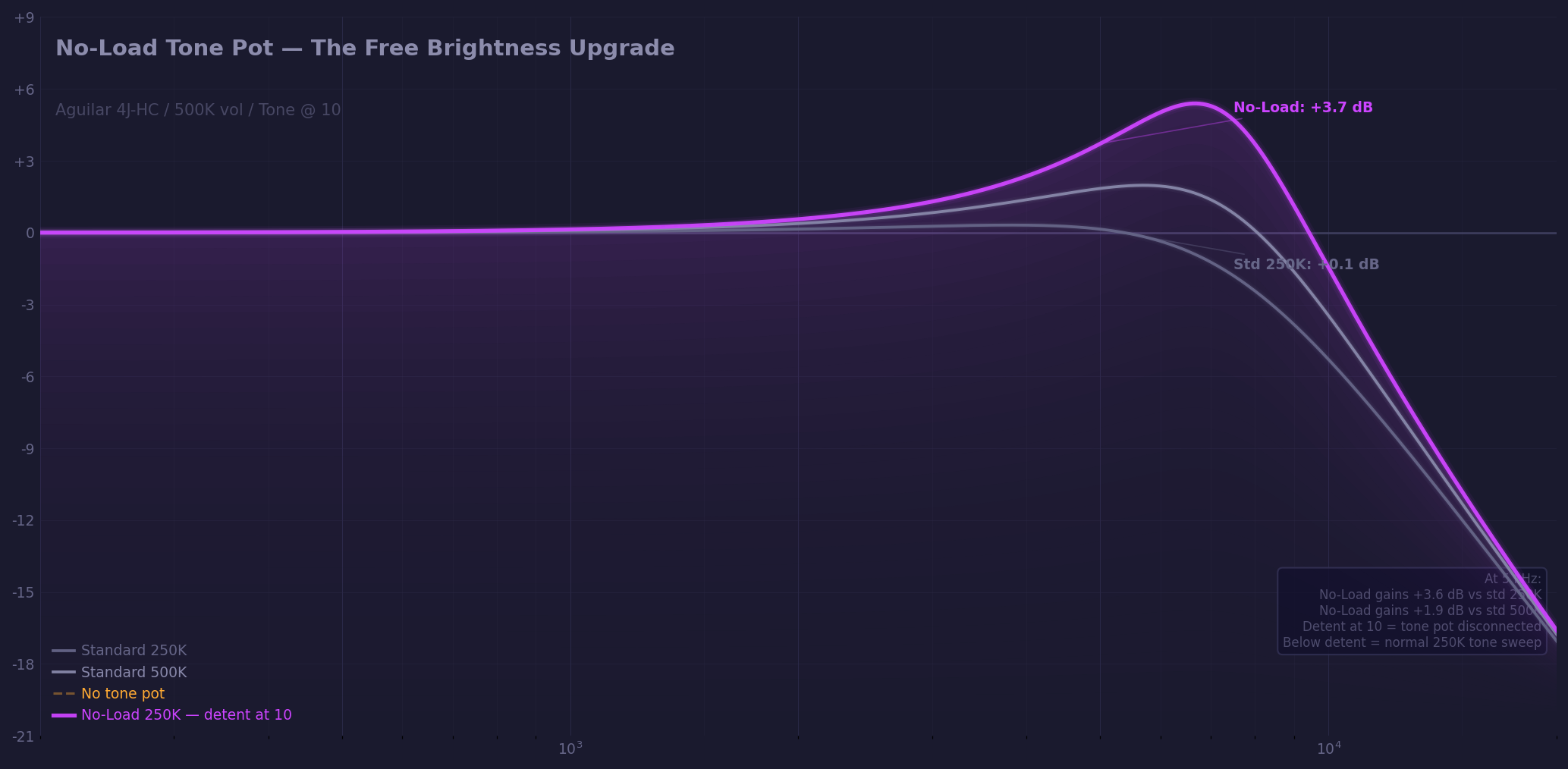
A standard 250K tone pot at 10 still loads the signal. It’s not zero resistance — there’s always a shunt path through the pot body to the cap and ground. Small, but it’s there. The no-load pot eliminates that path entirely at the detent. The pickup sees only the volume pot.
Below the detent, the tone knob gives 30-37dB of range at 3kHz depending on pickup. That’s a massive sweep from wide-open sparkle to rolled-off warmth. One knob, two completely different instruments.
Buffer first in chain
The landscape article assumed the pickup drives a cable directly into the interface. A 3m cable adds ~500pF of capacitance in parallel with the load. That eats treble — shifts the resonant peak lower, damps it. The pots add their own loading on top.
A clean buffer pedal first in the chain changes the equation. 1MΩ input, effectively zero cable capacitance. The pickup sees only the pots. Cable length after the buffer doesn’t matter.
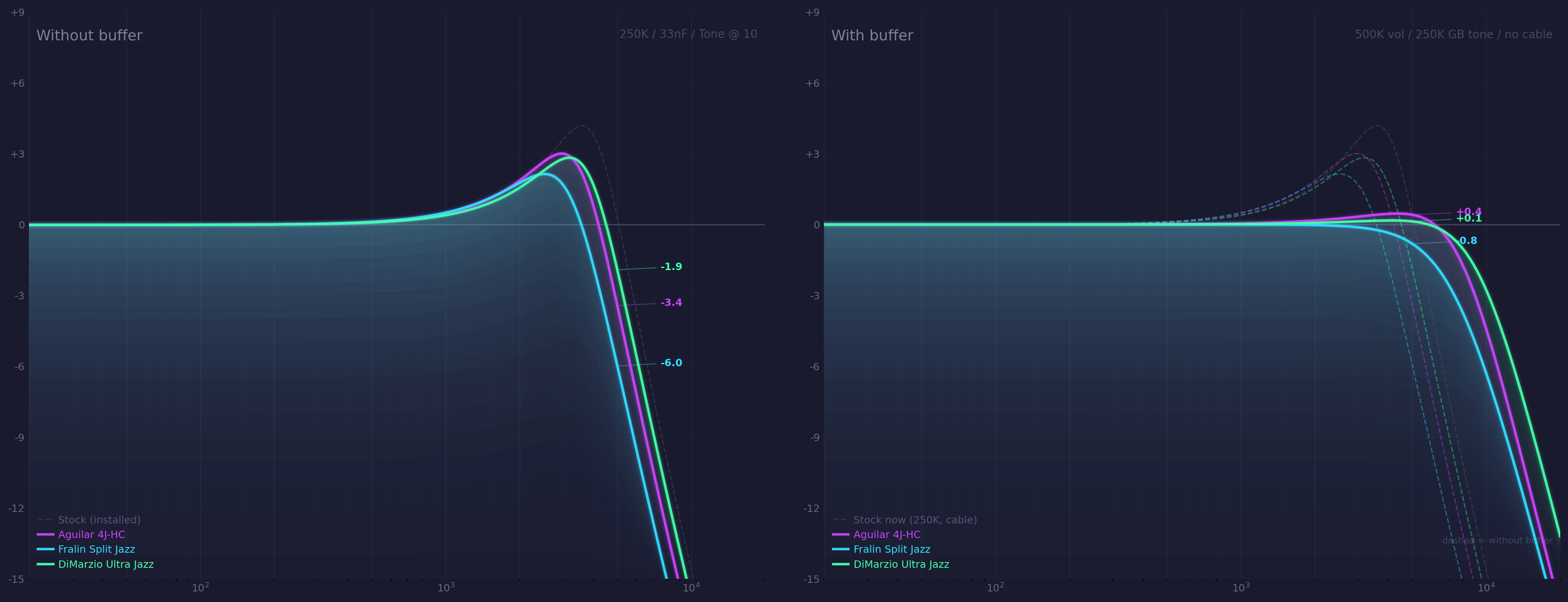
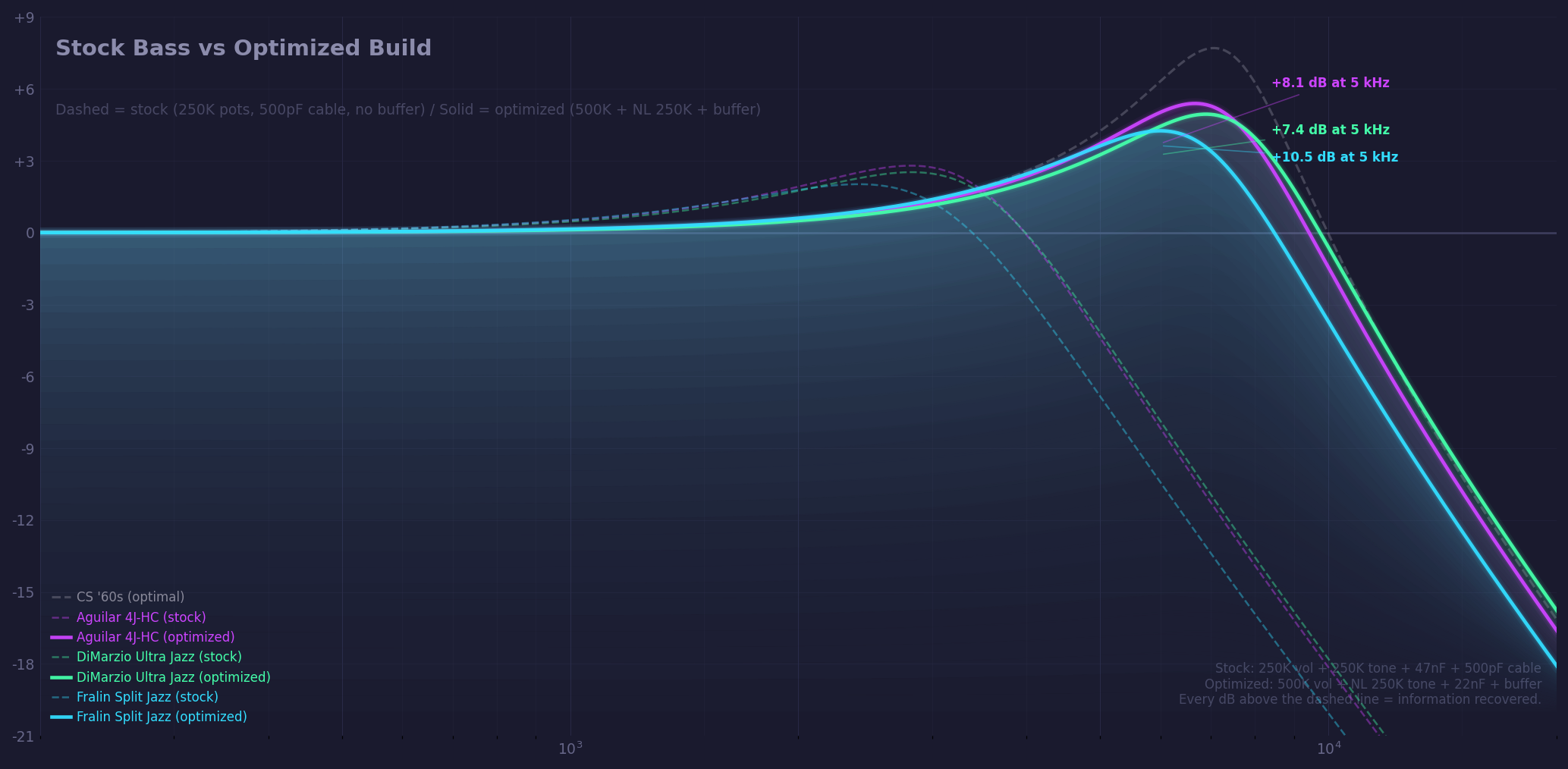
Left panel: the baseline. 250K pots, 3m cable, 1MΩ load. Right panel: buffer in chain, cable capacitance eliminated. Every pickup gets brighter, but the higher-inductance pickups gain more. The cable was hurting them disproportionately.
Optimal conditions
500K volume. No-load 250K tone at detent. 22nF cap. Buffer first in chain.

At optimal, every hum-cancelling pickup competes with the CS ’60s single-coil:
- Aguilar 4J-HC: +3.7dB at 5kHz, only -0.5dB behind the CS ’60s. Zero hum.
- Ultra Jazz: +3.3dB, -1.0dB behind CS ’60s. Zero hum.
- Fralin Split Jazz: +3.6dB, -0.6dB behind CS ’60s. Zero hum.
That’s the headline. Three hum-cancelling pickups within 1dB of the best single-coil Fender makes.
The Fralin surprise: at 1MΩ (theoretical max), the Fralin actually beats the CS ’60s by +0.3dB. Its higher inductance creates a taller resonant peak when loading is removed. The “warm Fralin” reputation comes from 250K pot loading, not the pickup itself.
The shootout at optimal
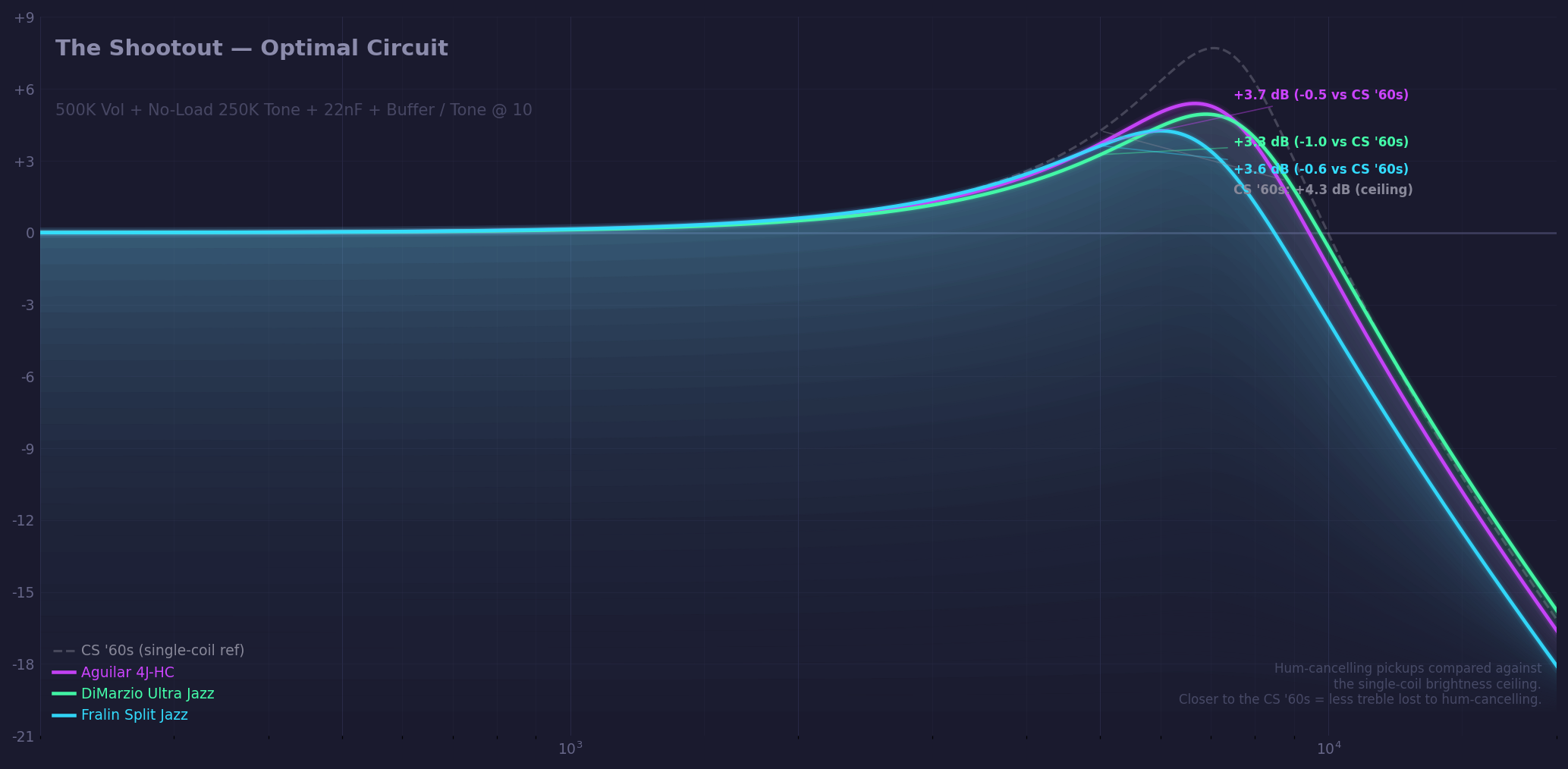
Pot values still swing more than pickup choice. With the 500K no-load config, the three hum-cancelling pickups span only 0.4dB at 5kHz (+3.3 to +3.7). Change to 250K pots and they all drop ~3.5dB. The circuit is the dominant variable. The pickup is the fine tuning.
Tone caps: 22nF
With the no-load detent, the cap only matters below the detent. At 10, every cap value is identical — disconnected.
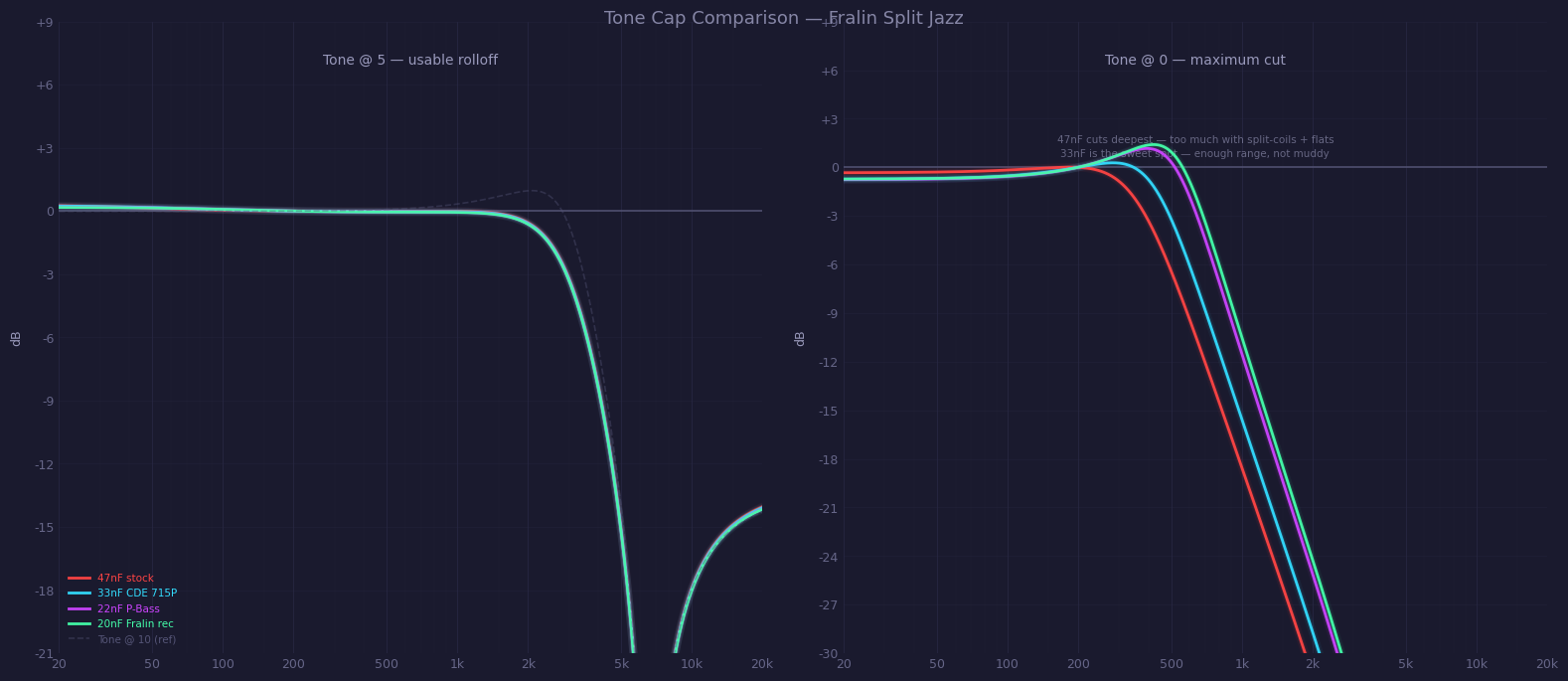
47nF (stock value) cuts too early with split-coil pickups and flatwounds. 22nF gives a gentler sweep that works better with higher-inductance hum-cancelling pickups. Fralin recommends 20nF for their pickup — 22nF splits the difference. More usable range before it goes dark.
Greasebucket below the detent
When the no-load pot drops below its detent, the Greasebucket circuit kicks in. A 4.7kΩ resistor in series with the tone cap, plus a 100nF cap from wiper to junction. At the detent, it does nothing — the pot is disconnected.
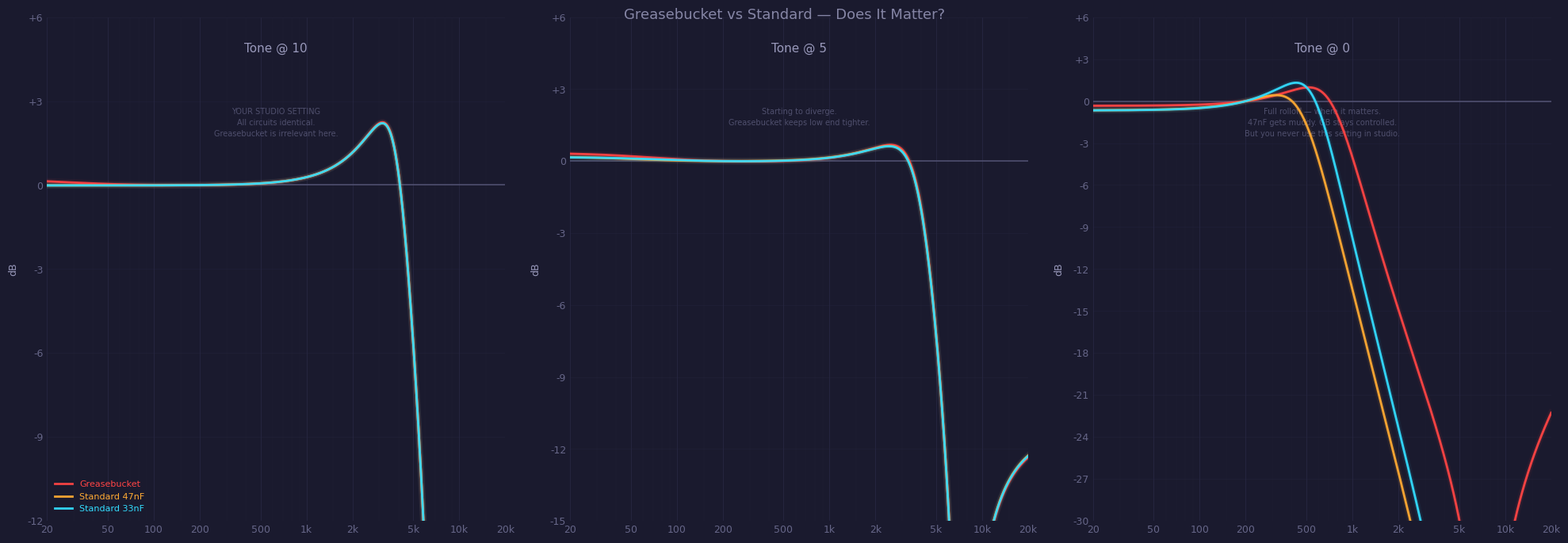
It earns its keep at tone 0. A standard tone circuit lets bass frequencies rise as treble drops — the woolly sound. The 4.7kΩ resistor limits the minimum impedance to ground, keeping the low end tight. ~7-10dB difference at tone 0.
The American Special came with one stock. Three extra components, completely transparent when not engaged. Insurance against mud.
Series mode
Push-pull on the volume pot. Both pickups in series instead of parallel. Doubles effective inductance, shifts the resonant peak lower. With the no-load tone pot at detent, the doubled series resistance (18-24kΩ) naturally damps the resonant peak — no pad resistor needed. Roll the tone below the detent to tame it further.
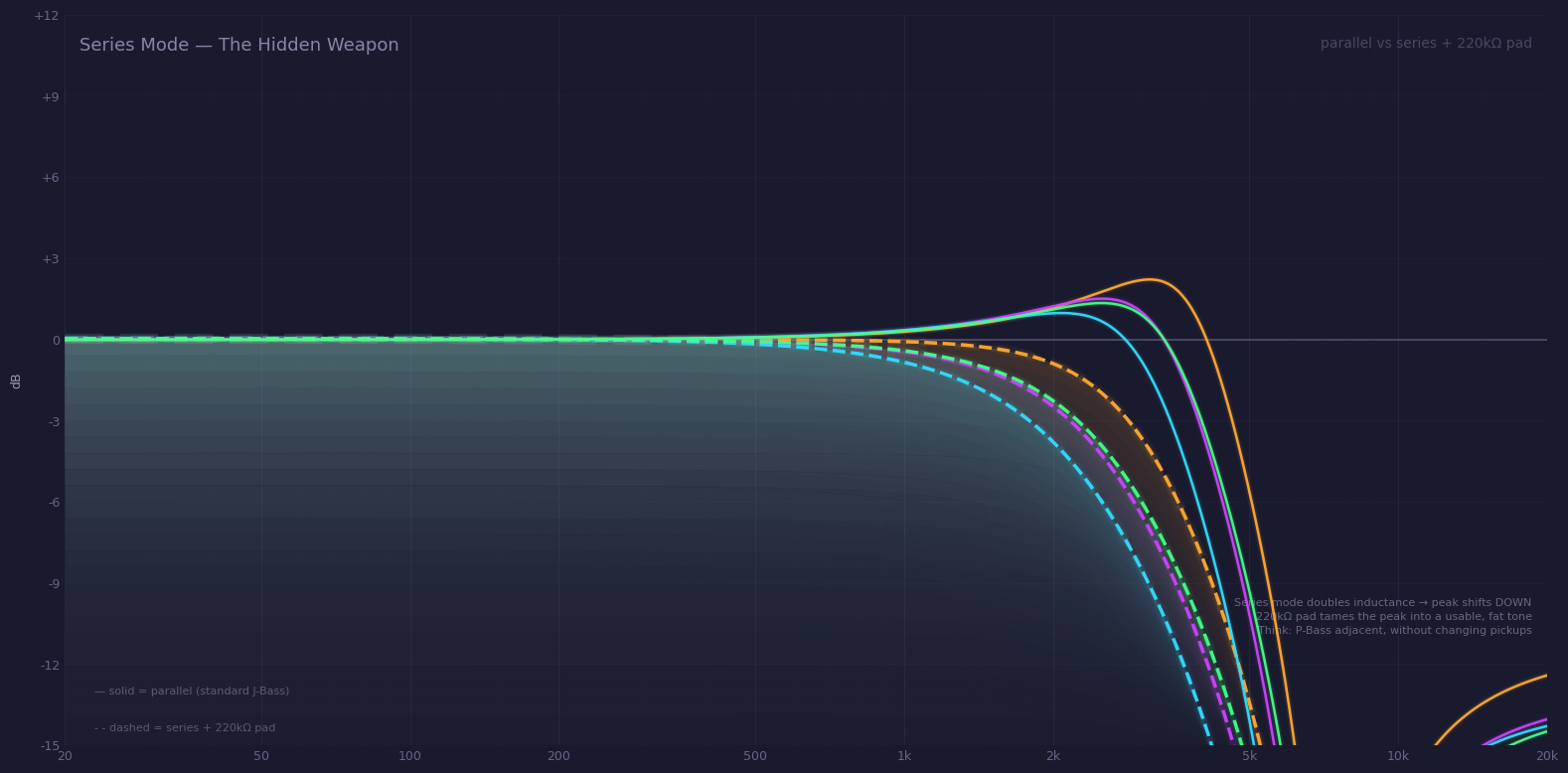
Parallel is classic J-Bass. Scooped mids, glassy highs. Series is P-Bass territory. Fat, mid-forward, punchy. Two instruments from one pair of pickups.
Treble bleed: skip it
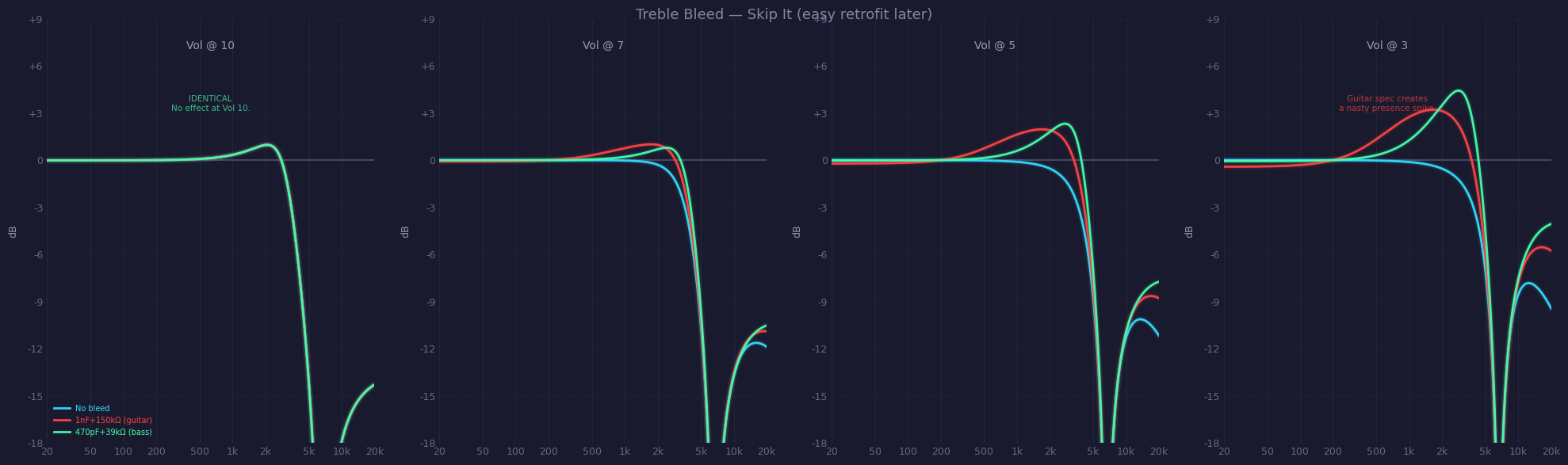
At volume 10 (primary studio setting), all options are identical. At volume 7, under 1dB. At volume 3, a guitar-spec network (1nF + 150kΩ) creates a honky presence spike. Bass doesn’t need it. Skip it. Two-minute retrofit if you ever want it live.
Before and after
Gray line: stock Vintage-Style single-coils through the factory circuit with 250K pots and cable. Colored lines: each hum-cancelling contender through the optimized build — 500K volume, no-load 250K Greasebucket tone at detent, 22nF cap, buffer first in chain.
Every hum-cancelling pickup now matches or exceeds the stock single-coil’s brightness. Without the hum.
You can EQ down in the mix. You can’t EQ back information that was never recorded.
The build

Everyday. Parallel mode, no-load tone at detent. Stock shown dashed for reference. Every hum-cancelling pickup recovers the treble the stock circuit was hiding.
P-Bass mode. Series, no pad. Fat, punchy, doubled inductance. The DPDT just switches series/parallel — no extra components. The no-load tone knob controls brightness from here.
Tone sweep. Rolling below the detent with the Greasebucket 22nF. Smooth, controlled. No mud.
500K volume. No-load 250K Greasebucket tone. 22nF cap. Buffer first in chain. Three knobs. Two modes. Zero hum.
Prediction
The sim can’t pick a winner. It can show where each pickup’s advantage lives.
Aguilar 4J-HC — most transparent. Closest frequency response to the CS ’60s single-coil (-0.5dB at 5kHz). If the goal is “replace the stock pickups, lose the hum, change nothing else,” the Aguilar gets nearest. Lowest DC resistance of the three means lowest self-noise from the winding. The refined option.
DiMarzio Ultra Jazz — most output. 250mV vs ~180mV. Roughly 3dB hotter before touching the preamp gain. Best signal-to-noise ratio by brute force. The hybrid magnet (Alnico 5 + ceramic) also means the harmonic content will differ in ways a frequency response model can’t capture — magnet structure affects how string vibration translates to signal, and that’s not in the curve.
Fralin Split Jazz — most range. Highest inductance (4.8H vs 3.8H) means loading affects it the most. At the no-load detent: brightest of the three relative to its loaded sound, with the strongest peak. Roll the tone below the detent: most dramatic change, warmest of the three. In series: deepest into P-Bass territory (9.6H effective). The no-load pot and the series switch have the most to work with because the pickup responds the hardest to loading changes.
Each pickup’s strength only matters relative to the others. The Aguilar is the most transparent, but the Ultra Jazz is close and louder. The Ultra Jazz is the hottest, but the Fralin’s range makes up for lower output with more tonal ground. The Fralin is the most versatile, but that only matters if you move the knobs — parked at the detent in parallel, its advantage disappears.
Three pickups going in. One comes out. The sim narrowed the circuit. Ears pick the winner.
The wiring guide has the full schematic.