Triads unlock the fretboard. Root, third, fifth. Three notes that tell you where you are over any chord. The idea is simple. Seeing it on the neck is not.
Two videos
Dani Rabin from Marbin walks through triad inversions across string sets (root position, first inversion, second inversion) then moves them horizontally. Not shapes to memorise. A way to navigate.
Janek Gwizdala does the same on bass with a different philosophy. Most players practise triads mechanically and still overthink them when playing. Janek’s approach: restrict yourself to a few shapes until they’re automatic. The goal isn’t knowing every position. It’s not having to think about the ones you know.
Same unlock from both. The triad gives you the chord tones, the notes that matter over any harmony. Everything else is decoration around those three points.
The spreadsheet
An Excel workbook. Pick a key, pick a chord number, it calculates the chord name, triad quality, and mode. Separate sheets for 4 through 8 string instruments, each with a fretboard grid that lights up the chord tones.
It worked. But it was static. Change the chord and you’re clicking cells, scrolling between sheets. No sound, no time pressure.
The tool
Fretboard Clarity replaced the spreadsheet.
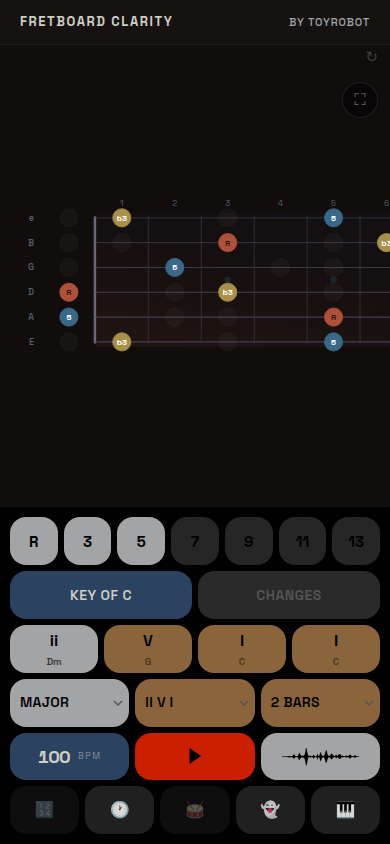
Pick a key, a scale, a progression. The fretboard lights up: gold for root, red for third, teal for fifth. Hit play and the chords advance on a metronome. Find the tones and play them before the bar moves on.
Seven interval toggles (R, 3, 5, 7, 9, 11, 13) control what appears on the neck, what the pad voices, and what the chord names read. Toggle the seventh on: the pad adds it, the label updates from C to Cmaj7. What you see, what you hear, what you read, all in sync.
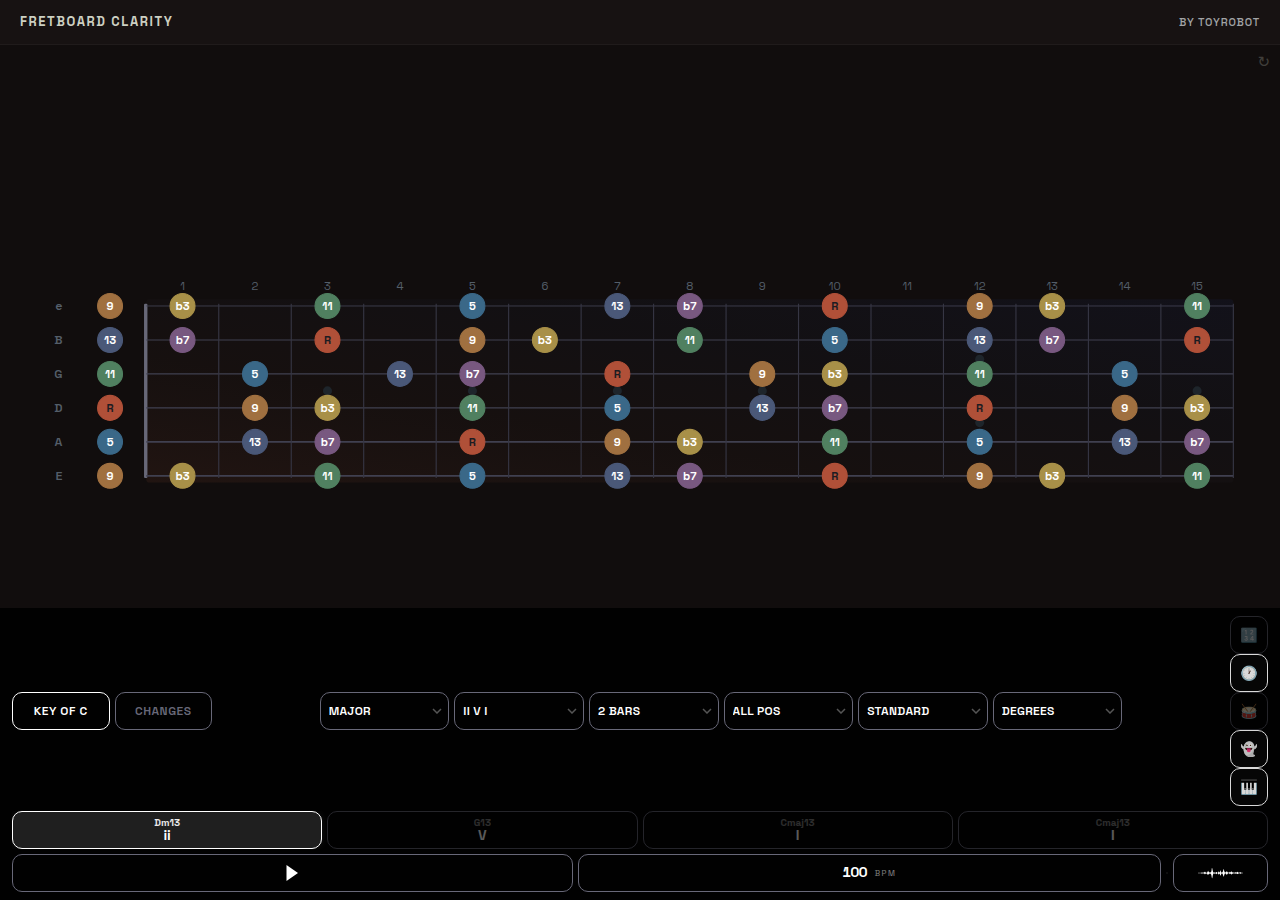
Start with R, 3, 5. That’s the Dani Rabin exercise. Add the seventh when triads feel automatic. That’s the Janek principle.
Six scale systems
Major and Natural Minor. Where most music lives.
Harmonic Minor. The raised 7th gives a dominant V chord. Phrygian Dominant. The tension sound in minor key jazz.
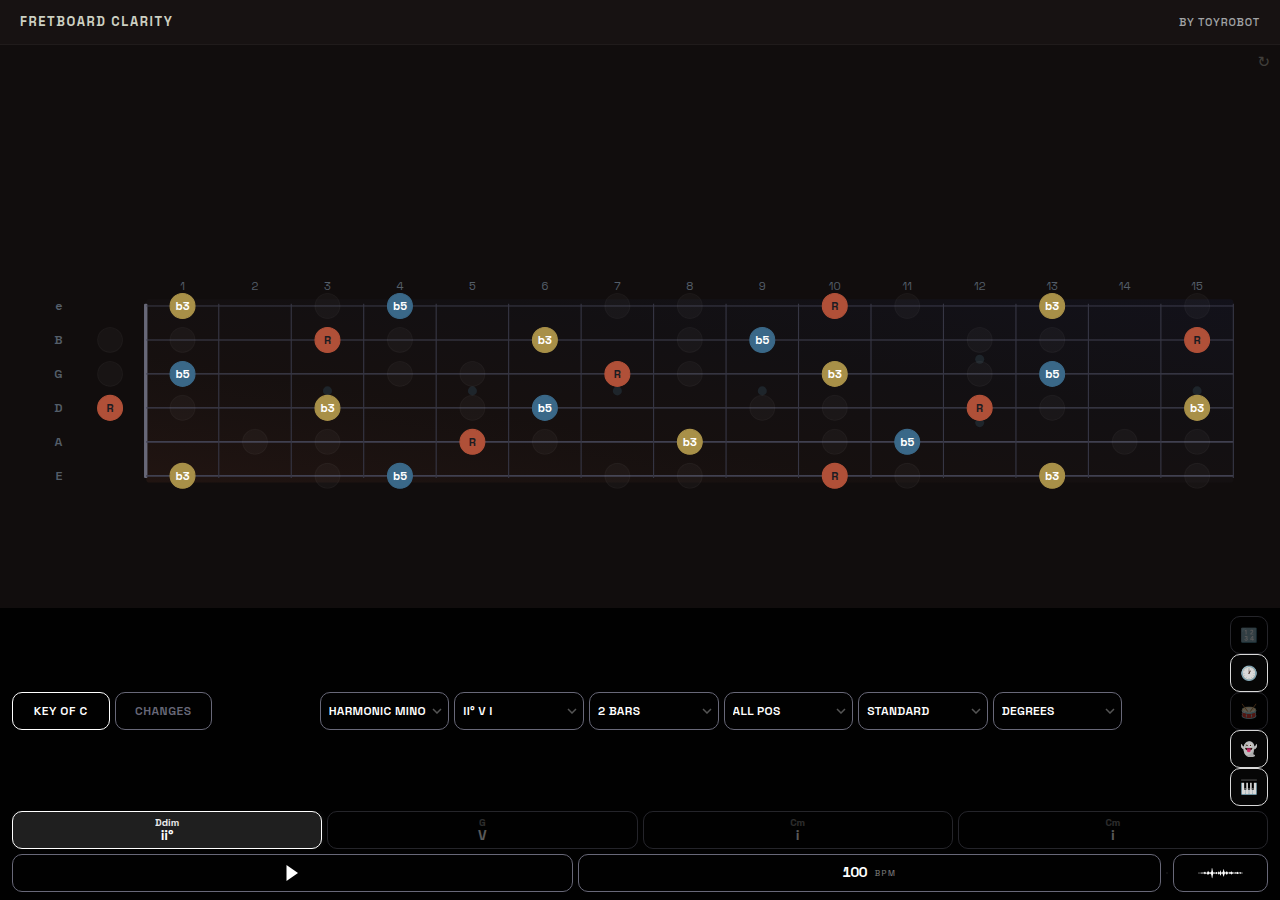
Melodic Minor. The Altered scale on VII. The substitution sound.
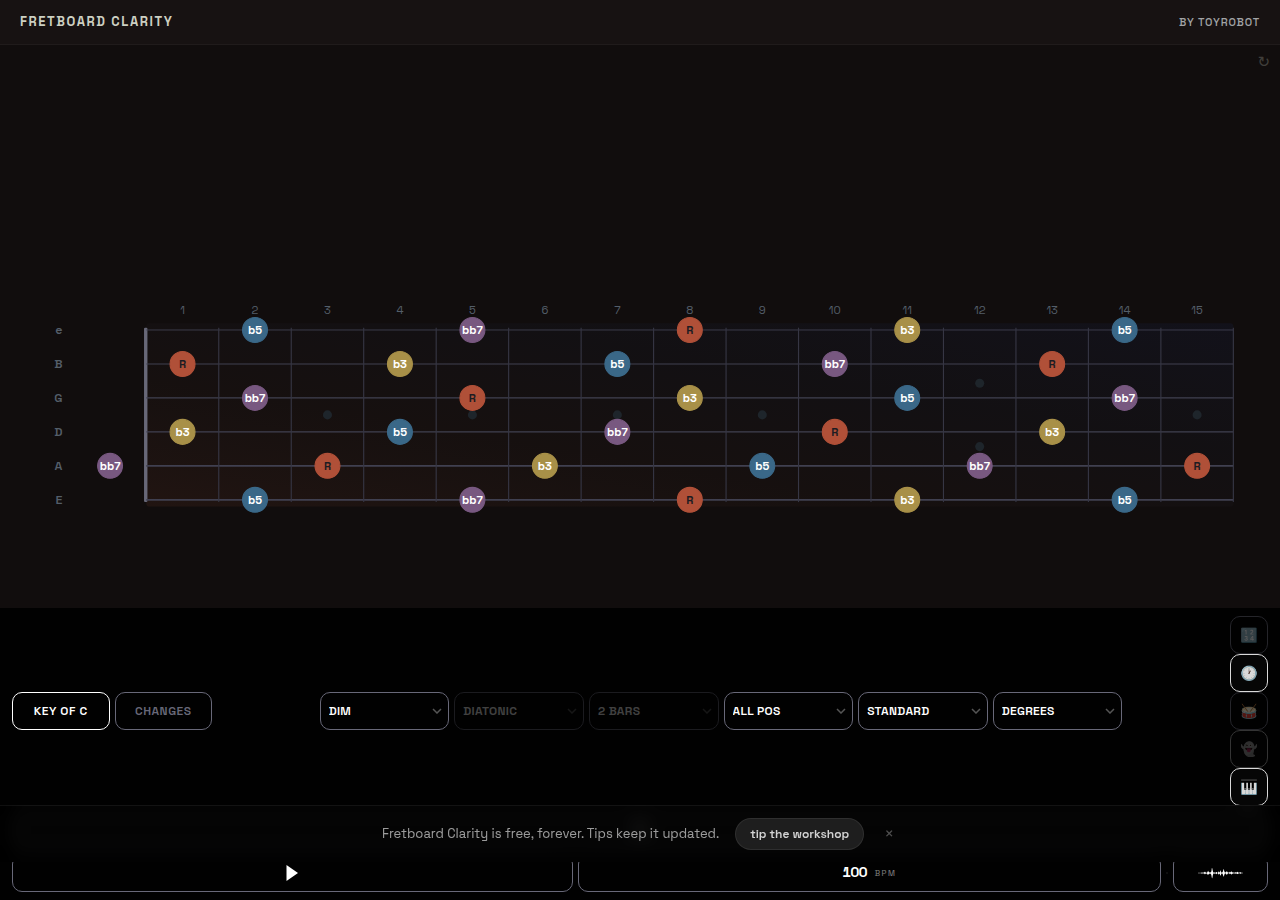
Augmented and Diminished. Symmetric harmony. The aug triad repeats every major third. The dim7 arpeggio repeats every minor third. The pad voices both correctly.
Progressions and positions
Ten built-in progressions. ii-V-I, I-IV-V, I-V-vi-IV, and more. Bars per chord: 1, 2, or 4. Diatonic mode holds a single chord. Tap to switch, no clock.
Five CAGED positions divide the neck into zones. Pick a chord, pick a position, learn what’s under your hand. Once every chord tone is reachable in all five zones, the whole neck opens up.
Borrowed chords
Below the diatonic table, a Borrowed section shows chords from parallel scales. The bVII from Natural Minor over a Major key. The V7 from Harmonic Minor. Tap one and the fretboard shows where the non-diatonic notes land.
Details
Pad voices exactly the intervals selected.
Metronome with click, drummer pattern, ghost overlay (next chord’s tones fade in before the change), count-in.
Shapes mode uses geometric indicators instead of (or alongside) colour. Circle for root, rounded square for third, diamond for fifth, triangle for seventh.
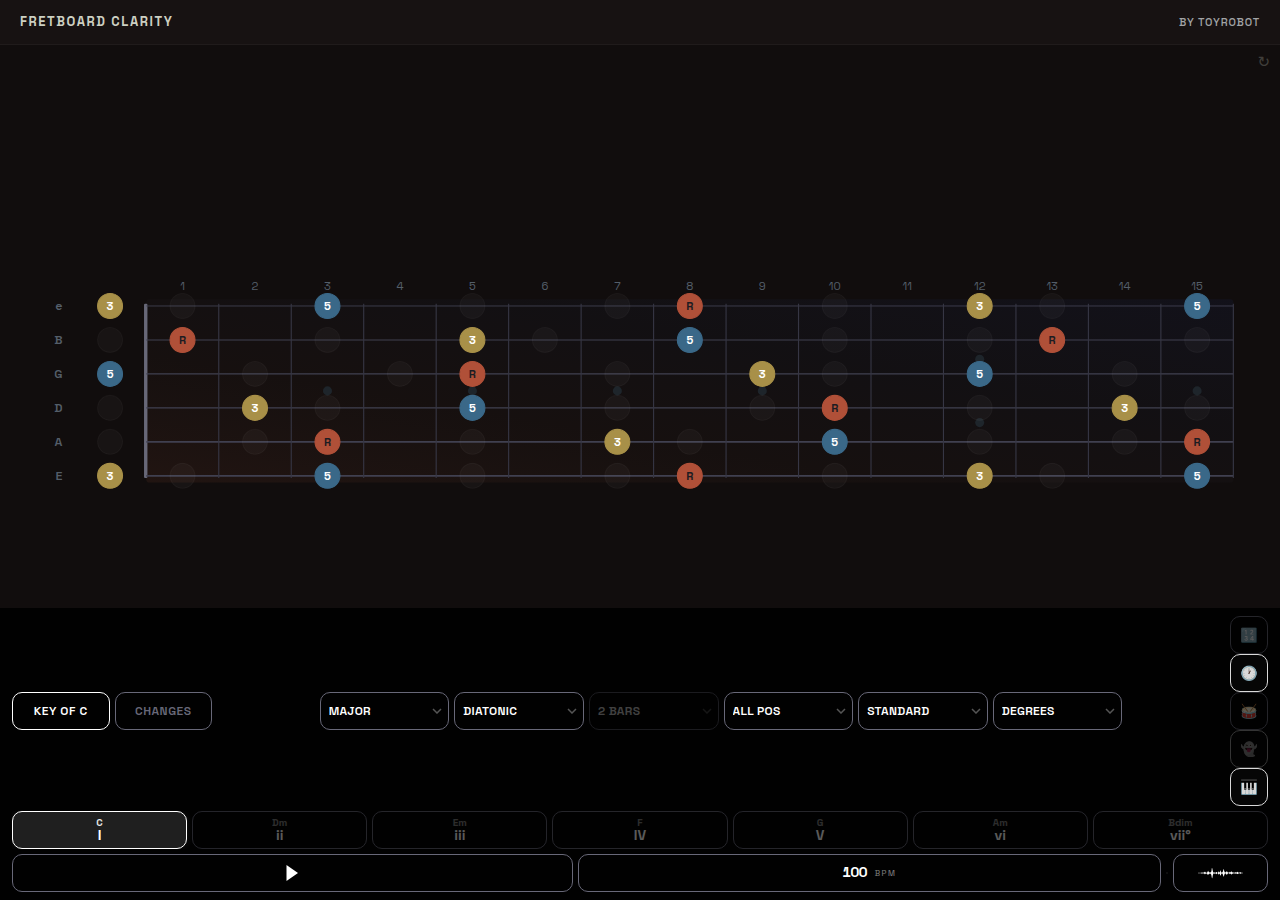
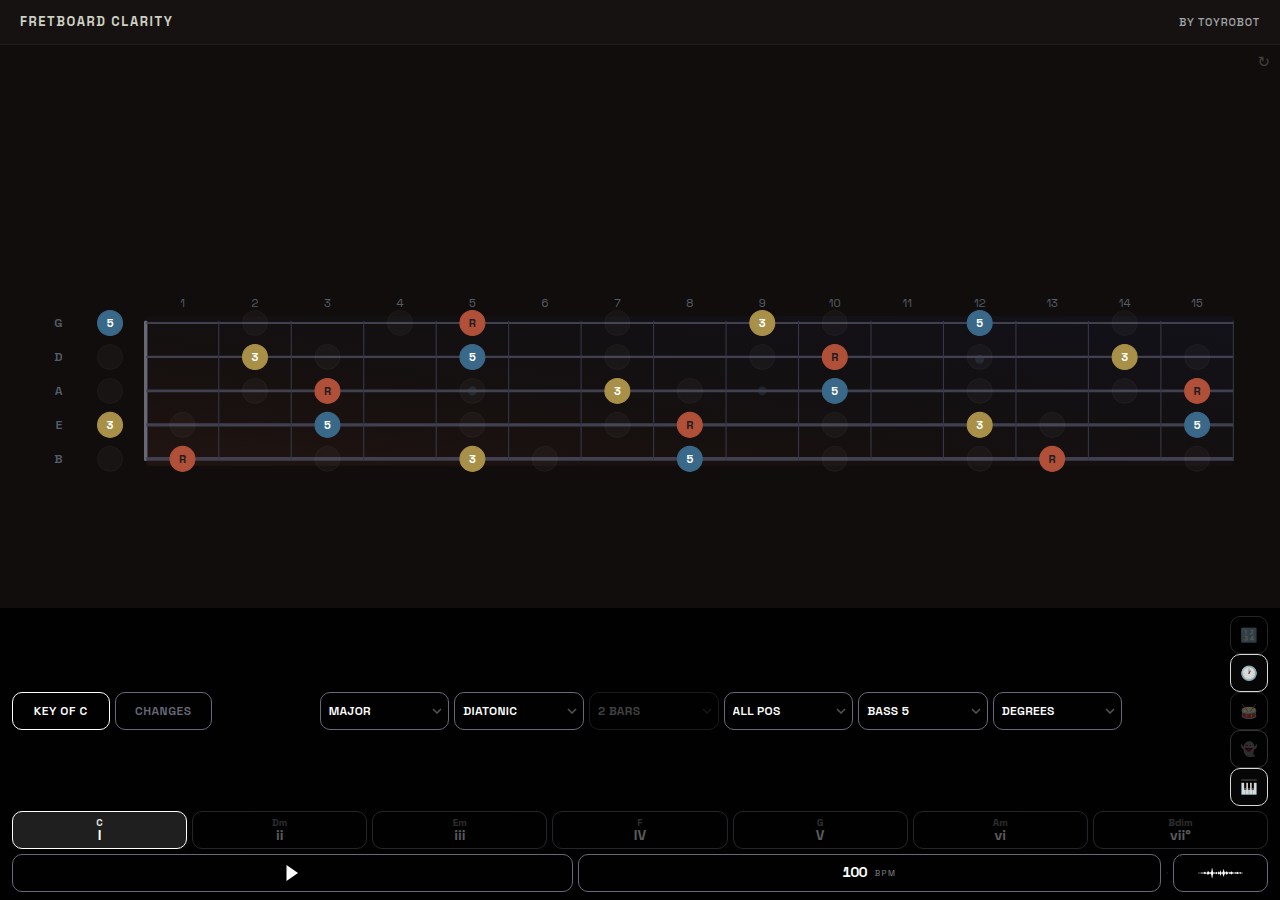
Tunings include Standard, Eb, Drop D, Drop C, Open G, Open D, DADF#AE, DADGAD, 7-string, 8-string, 9-string, plus bass in 4-string, Drop D, 5-string, and 6-string. Bass strings render wider and heavier.
Left-hand mode flips the layout. Nut moves right, positions recalculate.
Degree / note labels toggle between interval names (R, b3, 5) and pitches (C, Eb, G).
Custom chords
Build any voicing from the interval toggles. Not limited to diatonic harmony. Any chord, any colour, any position.
Built for the music stand
Phone on the stand, fretboard at the top, controls below. No scrolling during practice.