After Equator: What I'd Move a Seaboard To. Why Not Clone Equator?
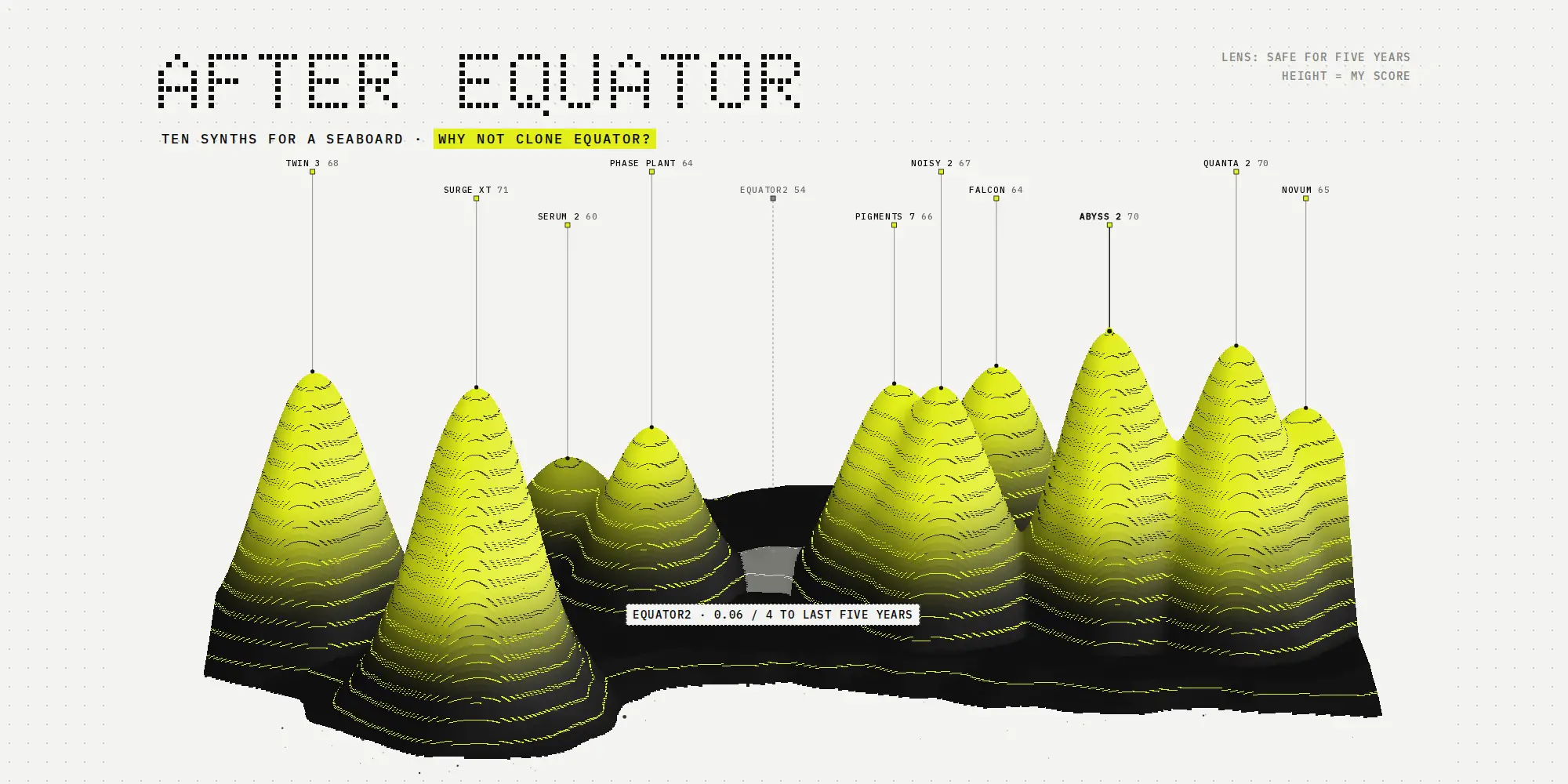
On 20 October, Luminary ROLI Ltd went into administration. Equator2 checks in with ROLI’s servers about every four weeks. Nobody has said what happens to those servers.
Every Seaboard thread since then asks the same thing: what do I play it with now? Here is my answer. It’s one player’s.
My lens
I play the Seaboard like a guitarist. Bends, vibrato, swells, one line at a time, simple chords. I want washes, tape-ish modulation, pads that move, leads that phrase like a guitar, and things that sound plucked or bowed. I learn an instrument by poking at it. I want a licence that still works offline in five years.
If you play it like a pianist, or you make bass music, my map will look wrong to you. It should.
I went through 40 MPE synths manual first. For each one: what the five dimensions do out of the box (Strike, Press, Glide, Slide, Lift), what the licence does when the maker disappears, and how much you get on the first evening. Then I scored them against my rig and my taste. Ten made the map. I haven’t played most of them yet, so read it as a shortlist, not a verdict.
Height is how hard I’d reach for it. Left to right runs from classic synth to texture and sampled sound. Front to back is price, free at the front. The grey island is Equator2, for scale.
The ten
Serum 2
Every modulation slot in Serum 2 has its own drawn curve with rise and fall smoothing, so each dimension can be shaped exactly. All five work. It sits low on my map for two reasons. Few of its factory presets are built for MPE, so the first evening is mostly setup. And my research filed its sound under the EDM and bass it’s famous for. That’s its reputation, not its range: sample, granular and spectral engines sit next to the wavetables. Readers who own an Osmose say the Serum 2 presets Expressive E made for Ctrl-e sound nothing like that reputation. Treat this number as my blind spot.
Abyss 2
The reason to own Equator was its presets: someone had built them for all five dimensions. Abyss 2 gets there another way. Its presets are built against four abstract inputs (onset, intensity, timbre, modulation), so you set up the Seaboard once and the whole library follows. Lift is there as a source. Cinematic, dark, ambient, and by every account hard to make sound cheap. The manual says the plug-in never contacts a server after activation, and one person makes it. This is where I’d start.
Surge XT
Free, open source, no activation. Surge XT can’t be taken off you. All five dimensions work, and its formula modulator hands you raw bend, pressure, timbre and release velocity to script however you like. The last stable release was August 2024; the work since then ships in nightly builds. It sounds digital and doesn’t pretend otherwise. If I could only keep one, it’s this, for the licence alone.
Twin 3
FabFilter added MPE to Twin 3 on 29 October, nine days after ROLI went under. Lift is a named source, and the manual has a section on the Seaboard’s Slide polarity. You paste in a licence key and that’s it, no activation server. Nobody has field reports on the MPE yet, me included.
Quanta 2
Granular from any recording you feed it. Press or Slide can push each voice’s grains around on its own. No copy protection at all, from Audio Damage.
Noisy 2
Eight voices at most and no Lift. Expressive E build the Osmose, so expression is the whole point of Noisy 2: resonant mallet, string and bell tones through to pads, and trigger modes that fire the envelope from how fast you move, anywhere in the key’s travel. The manual tells Seaboard players to turn the sensitivity up.
Novum
Novum splits a recording into its timbre and its movement over time, and Press and Slide walk through the pieces. Field recordings become instruments. The MPE section of the manual is one paragraph, so I’d expect to map this one by hand.
Phase Plant
Phase Plant can run its effects per voice. Hold three notes, press one harder, and only that note’s distortion opens up. That’s the demo on this list I’d want to hear first.
Pigments 7
Lots of people already own Pigments, and the presets are great. On a Seaboard, Slide only reaches the sound through Macro 1.
Falcon
Everything per voice, release velocity included. Falcon is the deep end: Slide does nothing until you write the script, so it’s the one I’d leave until the others are set up.
Why not clone Equator?
The other question in those threads: how do I rebuild my Equator patches in something else?
I wouldn’t.
What Equator had was the mapping. Press does something to a pad, Lift does something to a release, and none of that is the sound itself. It moves to any synth that has the dimensions.
The engine was never the point. Sound On Sound called Equator 1 “tailored to making a Seaboard sound good rather than being a fully rounded instrument”, and found Equator2’s sample player underpowered. Wavetables, granular and sample layers are all in Serum 2, Phase Plant and Falcon, and those are still being updated. Equator2 went from October 2023 to January 2026 without a release.
What Equator did have was a library: hundreds of presets made for all five dimensions. That lead is shrinking. Expressive E has spent the last year making MPE preset packs for other people’s synths: Phase Plant, Serum 2 inside Ctrl-e, and this week GForce’s MAP and Prophet~5. Some of them only unlock with an Osmose. None of them is Equator in another synth either. Each one sounds like its synth and like whoever designed it.
The best case for Equator’s engine, from a reader: every modulation connection has its own transfer curve, and they’re easy to reach. That’s real, and fewer synths can match it. On my list, Serum 2 has a drawn curve with rise and fall on every slot, Phase Plant has curvature on every modulation, and Abyss 2 puts a sensitivity curve on each of its four inputs. Outside the ten, free Vital has a remap curve on every connection. Twin 3 gives each MIDI source a choice of curve shapes. Surge XT has no per-route curve; you’d write it in the formula modulator. Whether any of them is as comfortable as Equator, I can’t tell you without the hours in. But curves are part of the mapping, and the mapping moves.
On my scoring, Equator2 is still second of the 40 for loading a preset and having the Seaboard sing. On lasting five years it scores 0.06 out of 4. A clone rebuilds the first number on a synth that doesn’t have the second problem, and costs you evenings to get there.
Of the 40 synths, twelve use release velocity at all, and four of those are ROLI’s. Clone an Equator patch into a synth without Lift and the copy has a hole in it. Clone it into one that has Lift and you spend evenings A/B-ing against Equator2, which phones home every four weeks.
If one patch is the sound of a record, sample it. Hold a few notes, print them, keep the audio.
For everything else:
- Bounce every Equator part in songs you care about. Print the audio now.
- Write down the gestures, not the parameters. For the five patches you love, one line each: Press opens the filter, Slide brightens, Lift lengthens the tail. Ten minutes.
My Equator 1 still opens offline with ROLI Connect quit. For how long, I don’t know.
Abyss 2 and Twin 3 go on the RISE first.
How I built this: AI research agents read each maker’s manual and changelog and tagged every claim with its source. A scoring model rated each synth on nine questions against a profile of my rig and taste, without comparing them to each other. The lens weightings are mine. Facts as of 31 October 2026, list prices in Germany. ≈ means the maker prices in US dollars.